
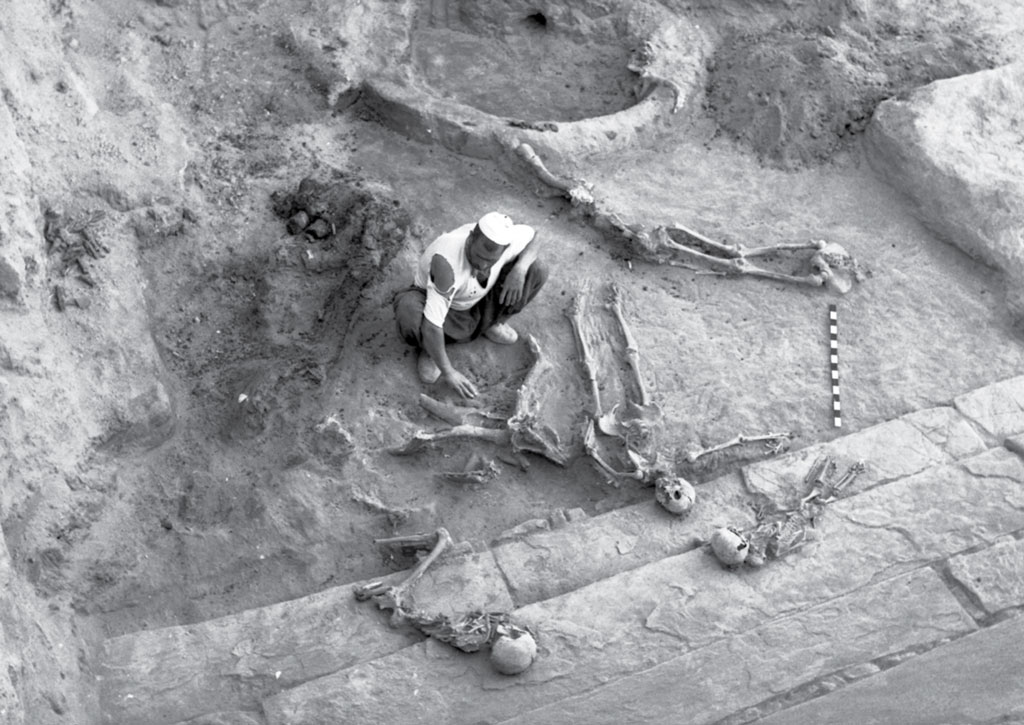
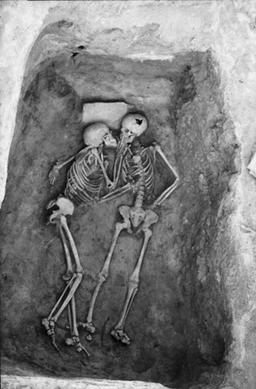
In 1972, a team of archaeologists excavating a burnt ancient city in northwestern Iran uncovered an astonishing sight hidden within a plaster-lined brick bin. Beneath the thick layers of ash and destruction dating back to 800 BCE, they found two human skeletons locked in a close embrace.
Devoid of any weapons, jewelry, or material treasures, these remains offered a rare, frozen glimpse into the final moments of a violent city-wide invasion. Known today as the Hasanlu Lovers, the exact identities of these two individuals and the unknown invaders who destroyed their home remain a subject of ongoing scientific research.
A City Consumed by Fire and Invasion
The city of Teppe Hasanlu was a thriving settlement located in the Qadar River valley near Lake Urmia. Around 800 BCE, an unknown and catastrophic attack decimated the site. Excavations spearheaded by Robert H. Dyson and a team from the University of Pennsylvania Museum uncovered immense devastation. They found thick ash, burnt mudbrick walls, and 246 human skeletons scattered across streets and buildings.
The nature of the destruction essentially froze the city in time. Victims suffered head lacerations and dismembered limbs from mass executions. The invaders’ identity—suspected to be Urartians or the Assyrian Empire—remains unconfirmed because the protohistoric city left no written records.
The Discovery Inside the Brick Bin
Amidst the extensive ruin of the city, the two skeletons were found isolated in a brick bin, entirely devoid of material possessions except for a single stone slab resting under one’s head. The skeleton on the right lay flat on its back, while the skeleton on the left rested on its side, reaching out with its right hand toward the other.
Because neither skeleton showed signs of lethal trauma or healed lifetime injuries, experts concluded they escaped the violent slaughter outside. Researchers determined the two individuals likely hid inside the covered bin and perished from asphyxiation when burning debris collapsed and sealed them inside.
Ancient DNA and Isotope Testing
For decades after the excavation, scientists debated the biological sex of the two individuals. Early assumptions labeled the left skeleton as female due to certain pelvic characteristics, prompting expectations of a heteronormative couple. However, advanced scientific analysis corrected these early hypotheses.
DNA testing definitively proved that both individuals were male. Dental and skeletal morphology indicated the right skeleton was a young adult between 19 and 22 years old, while the left skeleton was an older adult aged 30 to 35. Furthermore, oxygen isotope signatures verified that both men were born, raised, and sustained on local diets within the Hasanlu region.