
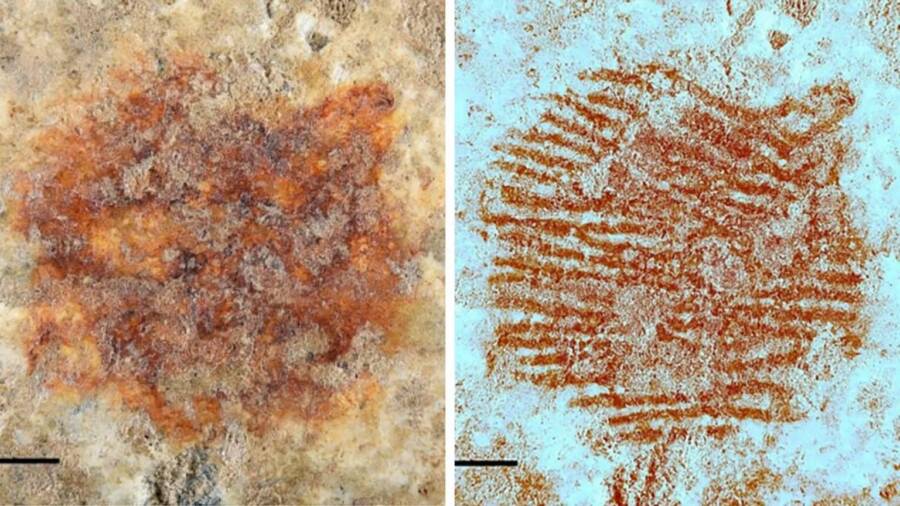
In 2022, deep inside the San Lázaro rock shelter in Segovia, Spain, an archaeological excavation unearthed a peculiar 7.8-inch stone that immediately caught the attention of researchers. The rock possessed a distinct physical shape resembling a human face, but what truly startled the excavation team was a single red ochre dot positioned exactly where a nose would be.
Upon closer multi-spectrum analysis, this small mark revealed a groundbreaking archaeological secret: the world’s oldest known fingerprint. Placed there 43,000 years ago by an adult Neanderthal male, this painted stone is providing scientists with unprecedented data regarding prehistoric human cognition and early artistic capability.
A Prehistoric Case of Pareidolia
When the research team from Complutense University in Madrid uncovered the stone, the facial resemblance was undeniable. Lead archaeologist David Álvarez Alonso explained that the researchers all looked at each other, instantly recognizing the shape of a face.
This psychological phenomenon of seeing faces in random objects is known as pareidolia. While experts have long known that Homo sapiens experience pareidolia, this discovery indicates that Neanderthals also possessed the cognitive wiring to recognize facial patterns in their environment. The Neanderthal who found this 7.8-inch pebble at a nearby river apparently saw the facial structure and decided to modify it.
The Red Ochre Dot and a Remarkable Fingerprint
To investigate the deliberate nature of the red dot, the archaeological team enlisted additional experts to conduct multi-spectrum analysis on the artifact. They discovered that the mark was created directly by a human finger. The fingerprint left behind belonged to an adult male Neanderthal who dipped his digit into red pigment and pressed it onto the stone.
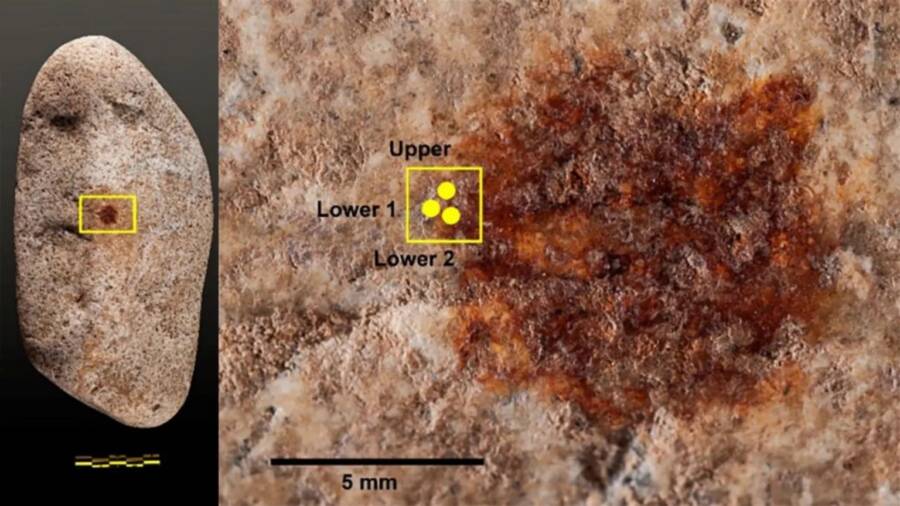
The researchers noted that this was a highly intentional action. There were no other similar markings found anywhere else in the cave to suggest the stone was utilized as a practical tool. Furthermore, the red ochre pigment did not naturally exist inside or outside the San Lázaro site, proving the individual had to transport the manmade pigment from an entirely different location just to mark the rock.
The First Known Neanderthal Portable Art
The Complutense University team formally published their findings in the journal Archaeological and Anthropological Sciences. During a subsequent news conference, Spanish officials and researchers, including Professor Andrés-Herrero, presented the artifact to the public.
Official Gonzalo Santonja stated that the Segovia rock is the only object of portable art painted by Neanderthals that has ever been recovered. Alongside holding the title of the first Neanderthal fingerprint ever identified, the marked stone stands as the first known pigment-altered object found in a confirmed Neanderthal archaeological context, challenging previous assumptions that only Homo sapiens produced art.