
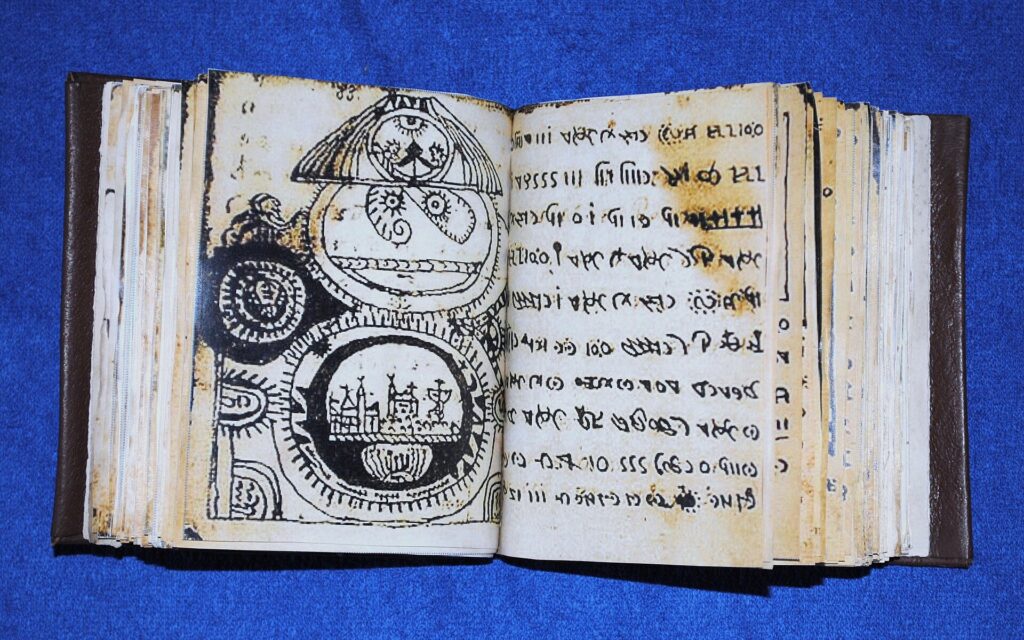
In 1838, a Hungarian count donated his entire library to the Hungarian Academy of Sciences, unwittingly handing over one of history’s most baffling mysteries. Among the volumes sat a small, 448-page illustrated manuscript written in an entirely unknown language.
Decades of intense study by linguists, historians, and cryptographers have yielded wildly different answers. Is it an intricate 18th-century hoax, a lost ancient dialect, or a complex code? Welcome to the enigmatic world of the Rohonc Codex, a historical puzzle that continues to defy a definitive universal solution.
A Baffling Discovery in Western Hungary
The manuscript takes its name from the city of Rohonc, located in Western Hungary. It surfaced when Count Gusztáv Batthyány gifted it alongside his massive book collection. Measuring just 12 by 10 centimeters, the volume boasts 448 paper pages.
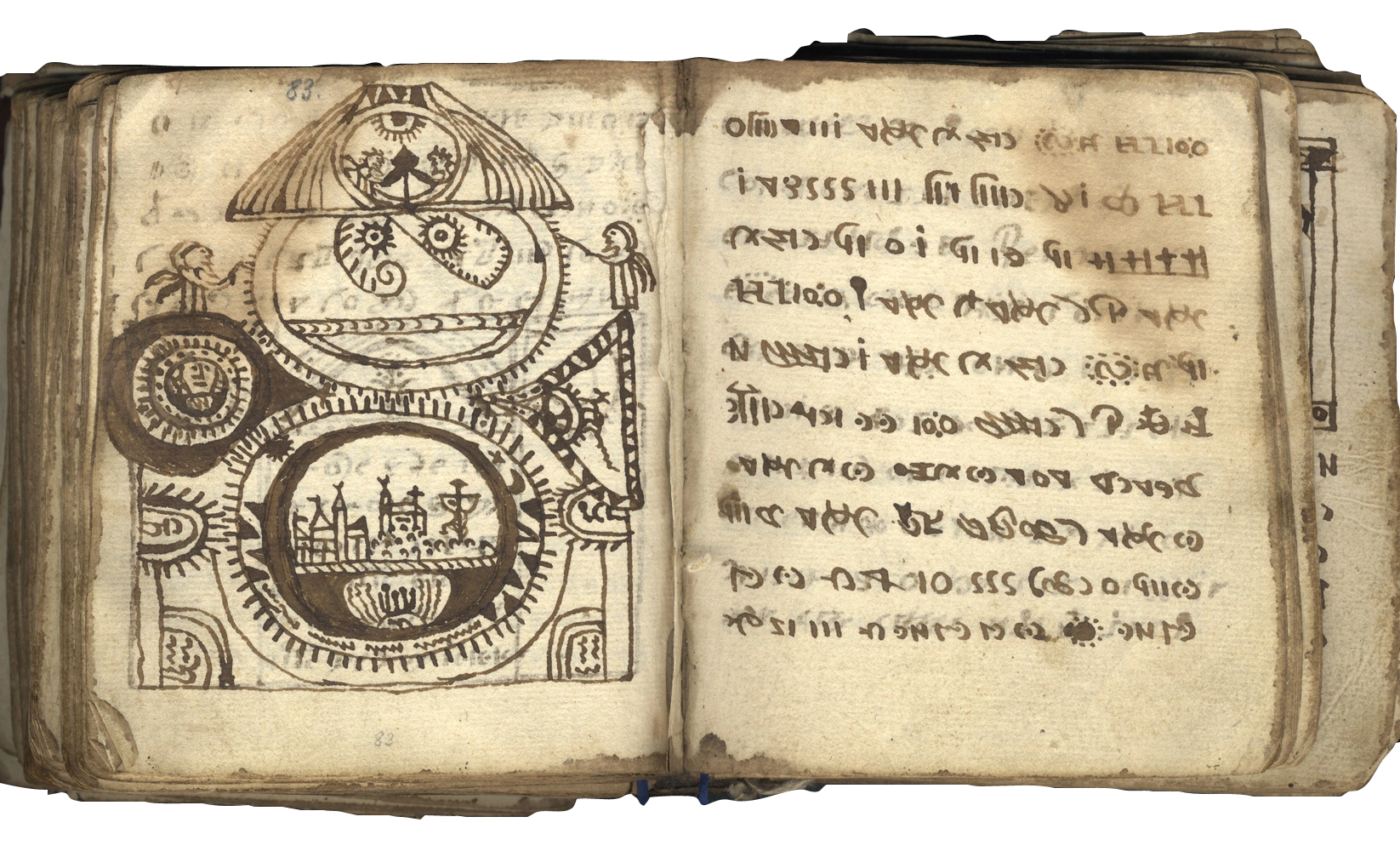
Physical analysis reveals it is likely Venetian paper manufactured in the 1530s. However, the text itself contains over ten times the number of characters found in any known alphabet. With nearly 800 distinct shapes recorded, researchers deduced the writing might represent a syllabary or logographic system, reading from right to left.
Intriguing Illustrations and Strange Characters
Beyond the baffling text, the book features 87 crude illustrations depicting military, laic, and religious scenes. These drawings showcase an unusual coexistence of different faiths. Visual representations of the cross, the crescent, and the swastika all appear together within the pages.
Because the shapes in the text are used with minimal repetition, early scholars quickly realized this was no ordinary alphabet. Throughout the 19th century, prominent academics and paleography experts examined the pages, but nobody could definitively read a single sentence.
Wild Hypotheses and Deciphering Attempts
As the manuscript gained fame, proposed translations emerged. In 1996, one researcher claimed the text was a Sumerian ligature. By turning the pages upside down, he produced a religious translation, which peers quickly dismissed. In 2002, a Romanian philologist published a translation arguing the text was vulgar Latin detailing 11th-century battles.
Two years later, an Indian researcher argued the text was a variant of the Brahmi script, translating into a Hindi apocryphal gospel. Each hypothesis faced immediate academic rejection due to inconsistent transliteration methods.
A Breakthrough in Modern Cryptography?
Systematic investigation eventually shifted the focus away from lost languages toward encryption. In 2018, researchers Gábor Tokai and Levente Zoltán Király published a study asserting the manuscript is a complex code system rather than a standard alphabet.
By identifying character strings matching the four evangelists and four-digit numbers representing years, they argued the book is a Catholic breviary. According to their findings, the text contains paraphrases of the New Testament and includes the year 1593. This cipher theory remains the most detailed mechanical breakdown to date.