
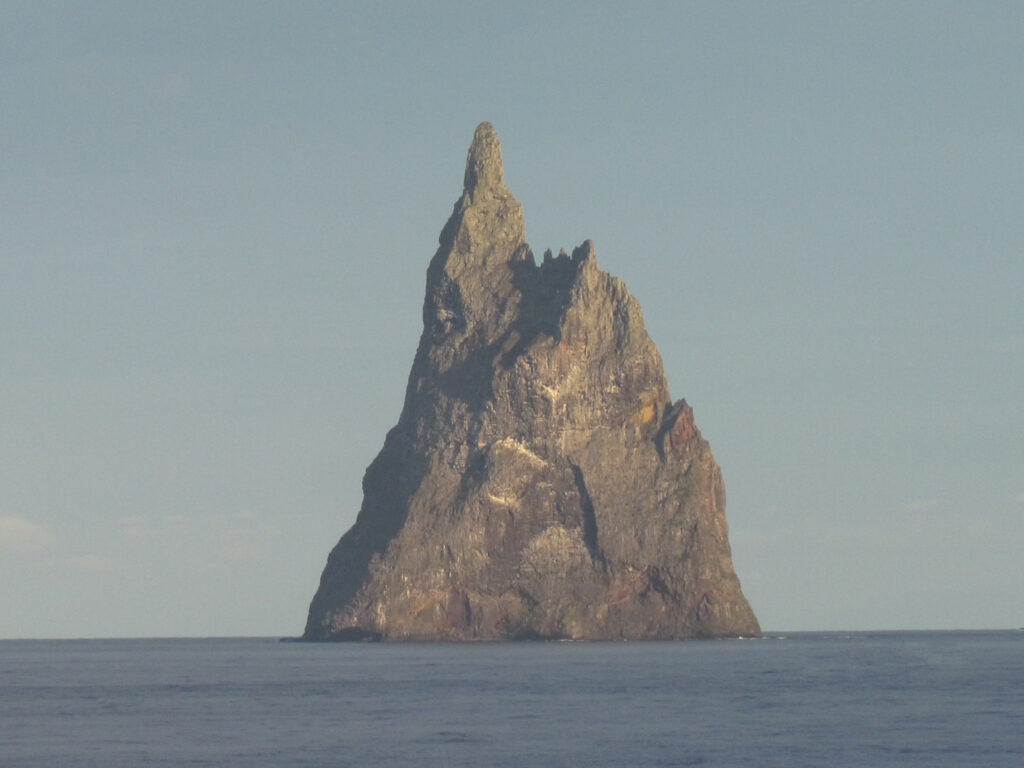
Rising dramatically from the Tasman Sea, 12 miles (19.3 kilometers) southeast of Lord Howe Island, stands a massive, jagged basalt monolith. Reaching a staggering height of 1,877 feet (572.1 meters), Ball’s Pyramid is officially the tallest volcanic sea stack on the planet.
Discovered in 1788 by Royal Navy Lieutenant Henry Lidgbird Ball, this isolated structure remained untouched by humans for nearly two centuries. Beyond its imposing geological formation, this solitary oceanic spire guards a fascinating biological secret—a creature science declared extinct nearly a century ago.
A Geological Giant in the Tasman Sea
Roughly 6.4 million years ago, a massive shield volcano erupted from the ocean floor on the Lord Howe Rise, part of the submerged Zealandia continent. Ball’s Pyramid is the hardened core of the magma chamber that originally fed this ancient volcano. Over millions of years, the relentless forces of wind, rain, and oceanic waves stripped away the softer outer layers of the volcano through a process known as differential erosion. The result is the near-vertical, dark, fine-grained basalt rock structure visible today.
Conquering the Vertical Spire
For many decades, the sheer walls of Ball’s Pyramid repelled all climbing attempts. Australian adventurer Dick Smith led the first recorded attempt in 1964 but retreated due to harsh conditions and low supplies. On Valentine’s Day in 1965, a team from the Sydney Rock Climbing Club, guided by Bryden Allen, successfully scaled the spire.
Allen utilized techniques honed on coastal sea-cliffs to navigate the swelling ocean and jagged rock face. Climbing the pyramid proved so perilous that the Lord Howe Island Board completely banned access in 1986, though scientists and climbers can now visit with special permits.
The Return of the Tree Lobster
In 1918, the introduction of black rats to Lord Howe Island completely eradicated the local population of the Lord Howe Island stick insect (Dryococelus australis). Scientists classified this large, flightless phasmid, often called the “tree lobster,” as completely extinct. However, the 1964 climbing expedition photographed a dead specimen on Ball’s Pyramid.
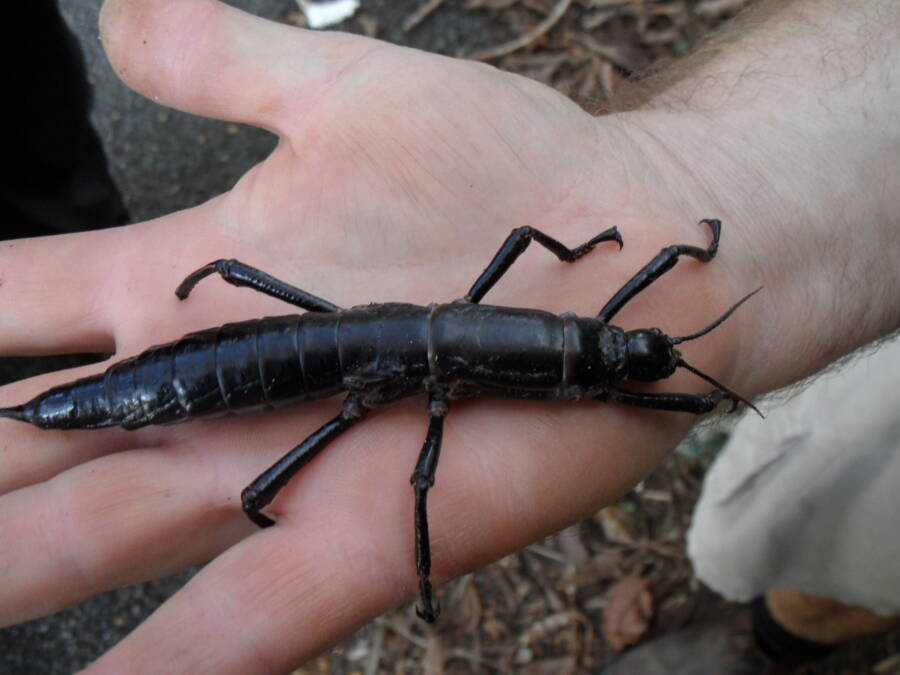
In 1969, climber Jim Smith recovered two exoskeletons. Finally, in 2001, researchers discovered a live colony subsisting on a tea tree (Melaleuca howeana) clinging to the rocky crevices. By 2003, two insects were relocated to the Melbourne Zoo to establish a captive breeding program.
Ongoing Scientific Exploration
To better understand this isolated ecosystem, the Australian Museum launched a major expedition in 2017. For three months, a team of 30 scientists documented the native flora and fauna.
They confirmed that the spire serves as a critical nesting site for seabirds, including shearwaters, terns, and gannets, which utilize the ledges to avoid terrestrial predators. Researchers continue to monitor the site, gathering data on the stick insect population and studying the ongoing effects of oceanic erosion on the 1,877-foot (572.1-meter) structure.