
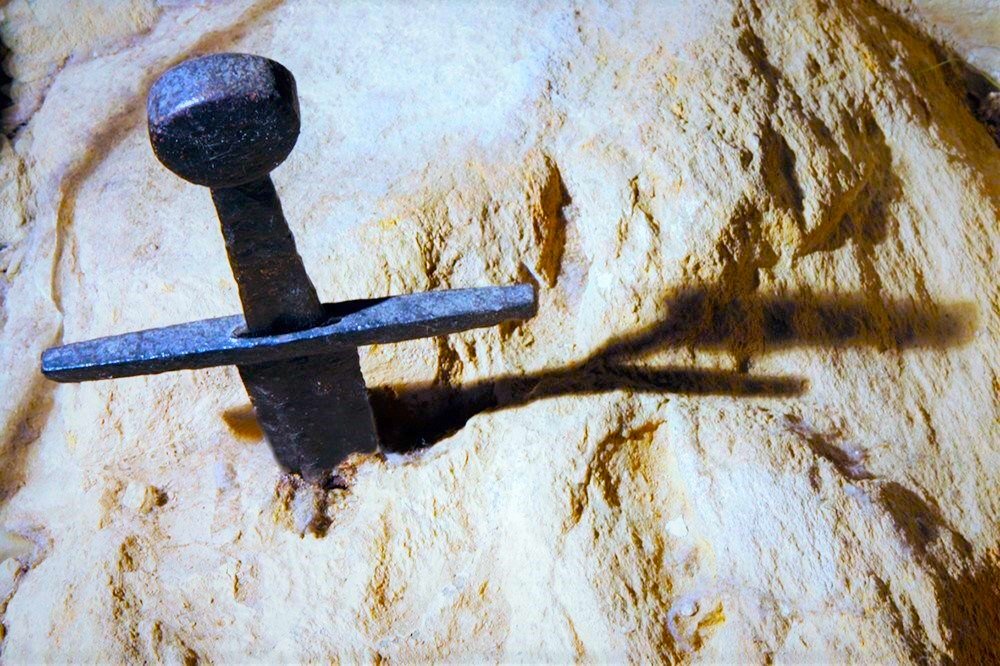
Hidden inside a small chapel in the hills of Tuscany lies an unusual artifact: a medieval sword plunged deep into solid rock. While popular culture heavily associates such a sight with the mythical King Arthur, this weapon belongs to a verifiable historical figure. In the 12th century, a violent knight named Galgano Guidotti drove his iron blade into a boulder, where it remains firmly lodged today. Complete with mummified hands and centuries-old mysteries, the history behind Italy’s weapon in the stone is far more fascinating than any folklore.
A Vicious Knight Abandons the Battlefield
Born around 1148 to a feudal lord in Chiusdino, Italy, Guidotti was a wealthy, arrogant knight known for his skill in combat and his extreme violence. In his early 30s, he reported experiencing a vision of the Archangel Michael and the 12 apostles, who instructed him to give up his worldly possessions and become a hermit. Guidotti pushed back, arguing that giving up his wealth would be as difficult as splitting a rock with his weapon.
Plunging the Blade Into Solid Rock
Following his vision, Guidotti abandoned his former life. While riding his horse to meet a potential bride arranged by his mother, the animal unexpectedly changed its path. The horse led him to the exact hilltop from his vision. To acknowledge the event, Guidotti thrust his sword into a nearby boulder. The metal easily slid into the rock, leaving only the hilt exposed in the shape of a cross. He lived the rest of his short life as a hermit on that very hill until his death in the early 1180s.

The Construction of Montesiepi Chapel
In 1184, Pope Lucius III canonized Guidotti. Shortly after his death, the Montesiepi Chapel was constructed directly over the boulder to enclose the sword. Today, the stone sits in the center of the chapel floor, shielded by a protective plexiglass dome to prevent visitors from trying to pull the hilt from the rock. The Abbey of San Galgano, a Cistercian monastery, was also built nearby in the 13th century and its ruins remain visible today.
Scientific Investigations and Mummified Hands
In 2001, scientists investigated the site to verify its age. Researcher Luigi Garlaschelli confirmed the metal composition and the weapon’s style match 12th-century origins, refuting claims of a modern forgery. Furthermore, ground-penetrating radar revealed an empty cavity beneath the stone, potentially housing Guidotti’s burial site. The chapel also displays two mummified hands, said to belong to an assassin who was attacked by wolves after trying to remove the sword from the rock. Radiocarbon dating confirmed these severed hands also date back to the 12th century.