
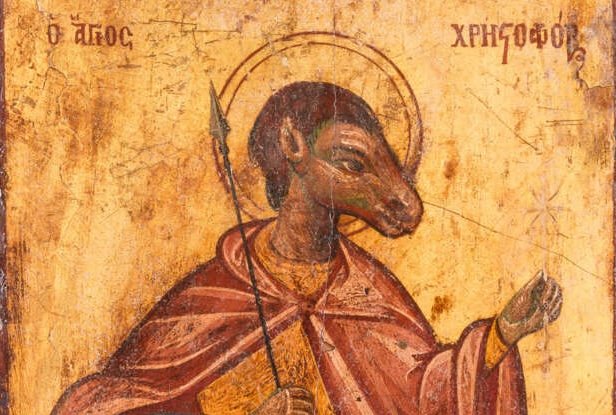
An unusual image exists within Orthodox Christian art: a robed and haloed figure with the head of a dog. This is St. Christopher, widely known as the patron of travelers. A viral TikTok video recently challenged the popular explanation for this canine appearance.
For years, many assumed a medieval scribe accidentally confused the Latin word Cananeus for Canaanite with canineus for dog-man. The actual historical record points away from a simple copying error and reaches into ancient maps, global folklore, and the boundaries of the known world.
The Global Obsession With Cynocephali
Before Christianity spread across Europe, ancient populations were already deeply familiar with the cynocephali, a Greek term that literally translates to “dog-heads.” Writers ranging from Pliny the Elder to Marco Polo populated the edges of their maps with societies of barking dog-headed people.
These figures emerged in cultures with no connection to one another, appearing across ancient Greece, Egypt, and Peru. When early Christians encountered these remote populations on maps and in texts, it sparked a theological debate regarding whether dog-headed people possessed human souls and required conversion.
The Conversion of a Dog-Headed Warrior
Legend states that Christopher began as a warrior cynocephalus from Canaan. A white-robed intermediary approached him and breathed into his mouth, giving him the power of speech. Following this encounter, he converted to Christianity and received the name Christopher, meaning “Christ-carrier.”
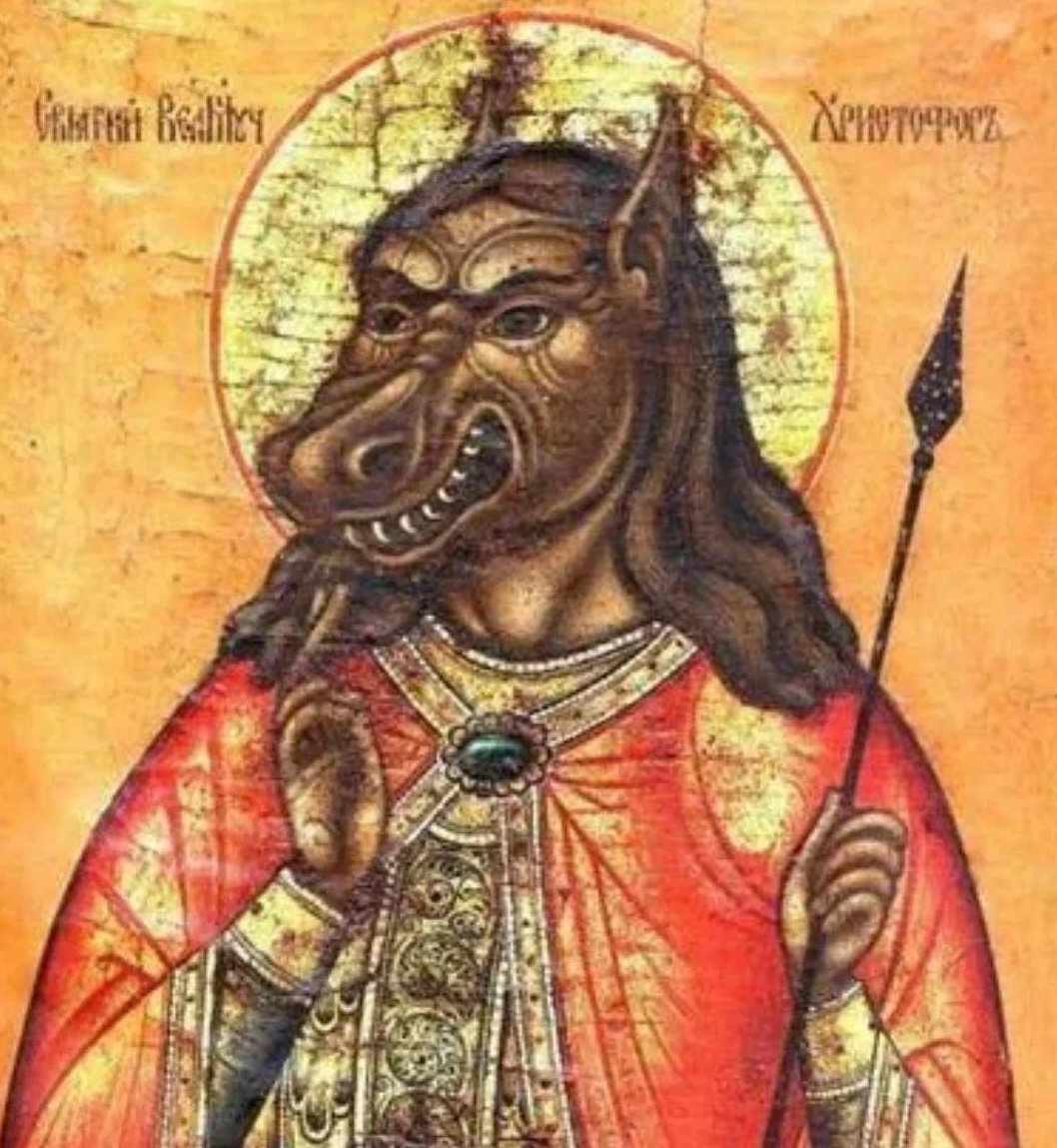
He was ultimately martyred by a Roman emperor. The Western Catholic Church eventually adopted a different narrative, portraying him as a giant carrying a child across a river until he realizes the increasingly heavy passenger is Christ.
The Persistence of Canine Iconography
In the Orthodox tradition, the dog-headed warrior saint persisted in art for centuries. Russian authorities formally banned the dog-headed figure in the 18th century. In spite of this ban, the canine form never disappeared entirely and survives in parts of Eastern Christianity today.
In medieval Christian thought, the cynocephali were the ultimate outsiders living beyond language and civilization. The dog head was a direct statement that even the most foreign being living at the margins of humanity could be transformed by faith.
Animal-Headed Deities Across Cultures
Holy figures with animal heads were common across the ancient world. Egyptian deities heavily featured animal characteristics transferred from observations of nature. Anubis presided over the dead with a jackal head, the war goddess Sekhmet had the head of a lioness, and Horus ruled the sky as a falcon-headed god.
Hindu traditions feature the widely worshipped elephant-headed Ganesha. Greek mythology produced the bull-headed Minotaur, the half-horse centaur, and the half-goat Pan. St. Christopher joins this extensive historical tradition connecting animals and religious figures.