
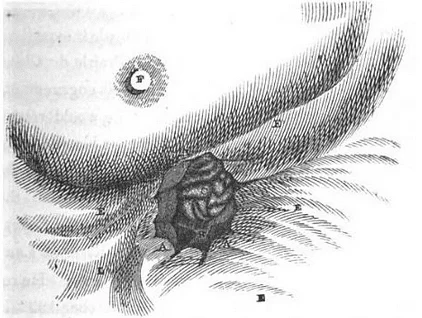
On June 6, 1822, a Canadian voyageur named Alexis Bidagan dit St-Martin was accidentally shot with a musket at a fur trading post on Mackinac Island. The blast tore a hole through his side, resulting in a perforated stomach, fractured ribs, and lung damage.
The severe injury formed a permanent fistula, connecting his stomach directly to his outer skin. This unclosed wound gave United States Army surgeon William Beaumont direct physical access to a functioning human stomach, leading to 238 internal experiments on the living patient.
Surviving a Devastating Musket Wound
Beaumont treated the young man. St-Martin suffered 11 days of fevers, breathing difficulties, and sloughing tissues. For the first 17 days, food he swallowed fell out of the open hole. Beaumont kept him alive using nutrient injections administered rectally until a rolled plug of lint secured by adhesive straps held the stomach contents inside.
After enduring a year of rib cartilage abscesses treated with surgical resections and topical acids, St-Martin recovered, though the gastric opening remained permanently unsealed.
Live Digestion Experiments Through a Gastric Fistula
Recognizing an opportunity to observe human digestion, Beaumont began his experiments in August 1825 at Fort Niagara. The doctor tied pieces of food to strings, suspended them directly into St-Martin’s stomach, and pulled them out to check the digestion progress.
Beaumont tested how the stomach reacted to fasting, exercise, and different emotional states. St-Martin worked as Beaumont’s servant, chopping wood and carrying loads between trials. Some procedures caused St-Martin pain, particularly when Beaumont placed sacks of food into his torso.
Fleeing to Canada and Scientific Discoveries
In September 1825, St-Martin returned to his native Canada, where he married and started a family. He remained away until 1829, when extreme poverty near Montreal drove him to rejoin Beaumont in Prairie du Chien, Wisconsin.
Beaumont published his findings in 1833, detailing 51 conclusions. He proved that vegetables digest slower than meat, milk coagulates early, the stomach uses a churning motion, and gastric juice contains hydrochloric acid.
Preventing a Medical Grave Robbery
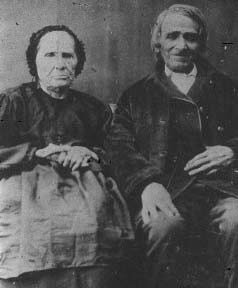
The men permanently parted ways in 1834 when St-Martin refused to return to Beaumont. St-Martin worked for other physicians and lived his final years in poverty.
When he died in Saint-Thomas, Quebec, in 1880, his family intentionally delayed his burial. They waited until his corpse began to decompose to deter medical men from stealing the body to remove his stomach or perform an unauthorized autopsy.