
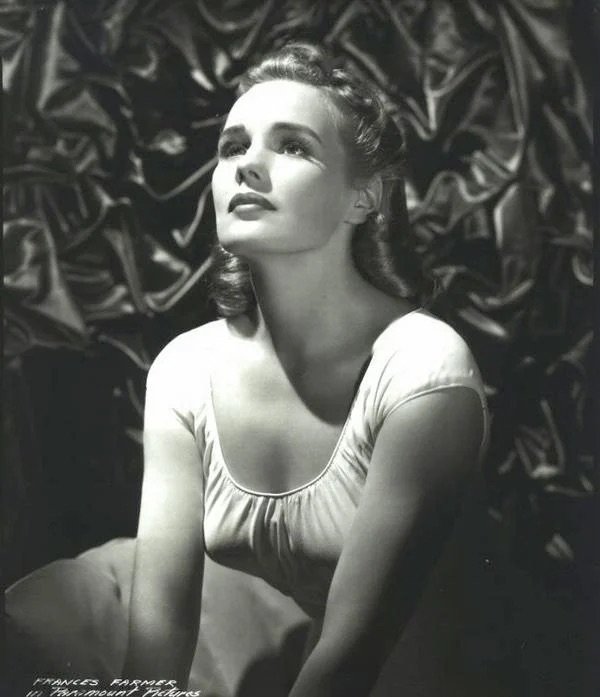
In the 1930s, Frances Farmer was one of America’s most famous movie stars, sharing the screen with actors like Bing Crosby. Yet, at the peak of her acting career, she was arrested, stripped of her legal competency, and forcibly committed to a psychiatric hospital for years.
For decades, fabricated rumors of a forced lobotomy overshadowed the verified events of her life. The actual sequence of events involves a rapid rise to fame, a series of severe legal and medical interventions, and a later return to television and theater.
Rapid Rise to Paramount Pictures Stardom
Born in Seattle in 1913, Farmer studied journalism at the University of Washington before moving to New York in 1935 to pursue theater. Instead, she signed a seven-year contract with Paramount Pictures. In 1936, her role opposite Bing Crosby in the film Rhythm on the Range made her famous almost overnight.
Despite studio executives demanding she embrace the Hollywood lifestyle, she prioritized stage acting, eventually starring in Clifford Odets’ play Golden Boy to national praise. She spent only a few months a year in Los Angeles for film work.
Arrests and Involuntary Psychiatric Confinement
In 1942, Farmer divorced her first husband and Paramount suspended her contract for refusing a role. In October, police arrested her for driving intoxicated with her headlights on during a wartime blackout. When she failed to pay her $500 fine, a judge issued a warrant.
On January 14, 1943, police forcefully arrested a naked and intoxicated Farmer at the Knickerbocker Hotel. After she fought officers and matrons during sentencing, she avoided 180 days in jail by transferring to a psychiatric sanitarium. Later, a judge awarded guardianship to her mother, who checked Farmer into Western State Hospital. She remained institutionalized there for nearly five years starting in 1945.
Debunking the Fabricated Lobotomy
During her time at Western State Hospital, an urban myth emerged claiming Farmer received a lobotomy. This claim was popularized by William Arnold’s 1978 book Shadowland. In a 1983 copyright infringement court case, Arnold admitted he completely fabricated the lobotomy narrative.
Farmer’s sister, Edith Elliot, documented that their father visited the hospital in 1947 and legally threatened the staff to prevent the procedure. Farmer did write in her posthumous autobiography about enduring ice baths and straightjackets, though the co-author later admitted to dramatizing parts of the text for publication.
Reclaiming Competency and Final Roles
Farmer was released from Western State Hospital in 1950. In 1953, a judge legally restored her competency, removing her mother’s guardianship. She relocated to California, worked as a bookkeeper, and eventually returned to the public eye.
By 1957, she appeared on The Ed Sullivan Show and later hosted a daily vintage film television series in Indianapolis until alcohol-related arrests led to her termination. She spent her final acting years as an actress-in-residence at Purdue University, starring in university stage productions. She died of esophageal cancer in 1970 at age 57.