
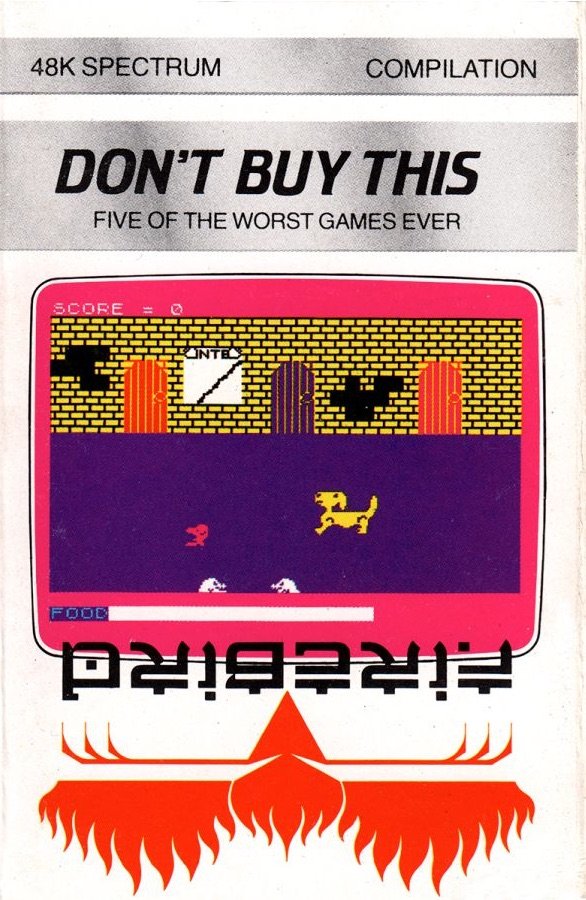
On April 1, 1985, a video game publisher did the unthinkable: they released a compilation of games they openly despised, titled it “Don’t Buy This,” and encouraged customers to pirate it. Instead of quietly rejecting the worst submissions they received, the software label Firebird bundled five fundamentally broken titles together for the ZX Spectrum.
They completely disowned their copyright and dared the public to experience the awful gameplay. What followed was a highly unusual commercial release that completely defied traditional marketing logic.
A Collection of Rejected Submissions
Firebird, a label operating under Telecomsoft, received countless amateur game submissions. They decided to take five of the lowest-quality games and bundle them into a single package under their budget Silver Range for £2.50. Marketing manager James Leavey stated the compilation “wasn’t released — it just escaped.”
Firebird explicitly told buyers that the games were entirely unoriginal. Going against industry standards, they gave up their copyright and actively encouraged users to copy and distribute the cassette tape for free.
Dogs with Lasers and Broken Race Cars
The compilation featured titles with severe design flaws. In Weasel Willy, players controlled a supposedly weasel-like character that looked human. The game randomly generated trees across the screen, sometimes spawning them directly on the player, causing an instant and unavoidable game over. Race Ace presented a racing track where the player’s car could only turn at 90 and 180-degree angles.
Computer-controlled opponents instantly accelerated whenever the player turned, making it mechanically impossible to win. Evidence indicates Race Ace was actually developed in 1983 by Firebird co-creator Tony Rainbird. The package also included Fido 1 and Fido 2: Puppy Power, where a dog avoided low-flying canaries and shot laser beams from its eyes.
Sarcastic Instructions and Impossible Odds
The fifth game, Fruit Machine, offered an incredibly slow-moving slot machine simulation. Firebird’s official instructions sarcastically described it as a mysterious game requiring absolute concentration, suggesting users play it in the middle of the night while sleeping. C
ritics found themselves entirely confused when reviewing the compilation. Magazines like Your Spectrum and Sinclair User gave it abysmal scores, noting it was difficult to properly critique a product that openly advertised its own lack of quality.
Commercial Success Despite the Warnings
Despite the terrible review scores and the publisher’s explicit warnings to avoid purchasing it, Don’t Buy This became a commercial success. Consumers bought the tape in large enough numbers that the release generated a profit. Firebird offered stickers and badges to consumers who took the time to write to the company regarding the games. The financial return was high enough that Firebird considered releasing a follow-up, brainstorming working titles such as Don’t Buy This Again and Don’t Buy This Either.