
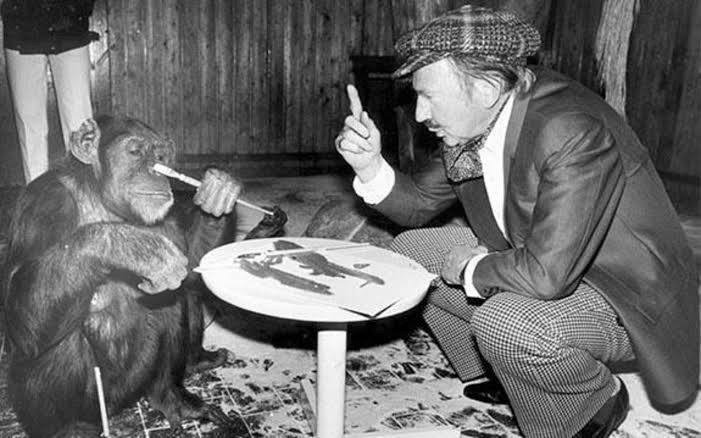
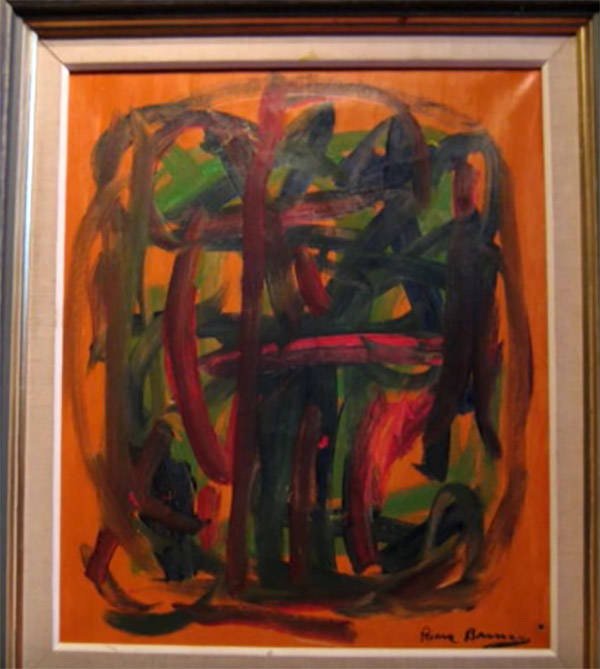
In 1964, the avant-garde art scene in Gothenburg, Sweden, was captivated by the arrival of a previously unknown French painter. Critics eagerly gathered at a local gallery to examine a series of bold, abstract canvases. They praised the powerful strokes and the clear determination behind the artwork.
One critic even compared the creator to a delicate ballet dancer. However, the celebrated painter was not a French prodigy. His real name was Peter, and he was a four-year-old common chimpanzee from a local zoo. The exhibition was an elaborate hoax designed to test the limits of modern art criticism.
Testing Modern Art Critics
The scheme was devised by Åke “Dacke” Axelsson, a journalist working for the Swedish tabloid newspaper Göteborgs-Tidningen. Axelsson wanted to see if professional art critics could genuinely differentiate between true avant-garde modern art and the brushstrokes of a non-human primate. He created the fictional identity of “Pierre Brassau,” an obscure French artist whose work was allegedly making its debut in Sweden.
A Primate With a Paintbrush
Axelsson traveled to the Borås Djurpark, a zoo located in western Sweden, to find his artist. There, he located Peter, a four-year-old chimpanzee. The journalist successfully persuaded Peter’s 17-year-old animal keeper to give the primate a set of brushes and paints. Peter began applying paint to the canvases provided to him. Once the chimpanzee created several paintings, Axelsson evaluated the collection, selected the four best pieces, and prepared them for public display under the Pierre Brassau pseudonym.
Gallery Exhibition and Critical Acclaim
Axelsson arranged for the four selected canvases to be exhibited at the Gallerie Christinae in Gothenburg. When the doors opened, the art community examined the pieces. While one skeptical critic prophetically observed that “only an ape could have done this,” the majority of reviewers offered praise.
Rolf Anderberg, writing for the Göteborgs-Posten, published a glowing review. He stated that Brassau painted with furious fastidiousness and described the brushstrokes as twisting with clear determination. A private collector purchased one of the paintings for $90, equivalent to roughly $934 today.
The Aftermath of the Hoax
Shortly after the glowing reviews were published, Axelsson revealed the true identity of Pierre Brassau. Despite the exposure of the hoax, Anderberg refused to retract his initial assessment. The critic insisted that Peter’s work was still the best painting in the entire exhibition. Peter’s career as a celebrated avant-garde painter ended after the reveal. In 1969, the chimpanzee was transferred from Sweden to the Chester Zoo in England, where he lived out the remainder of his life.