
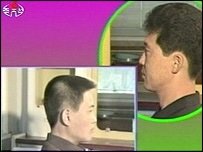
In 2004, a state-run television broadcast informed an entire nation that growing their hair too long would consume their brain’s nutrition and reduce their intelligence. The North Korean government aired a program titled “Let’s trim our hair in accordance with the socialist lifestyle” to regulate the physical appearance of its citizens.
The campaign linked grooming habits directly to hygiene and mental capacity. To enforce these standards, the state deployed a media strategy utilizing hidden cameras, strict measurement guidelines, and national broadcasts to publicly identify citizens who violated the dress code.
A Guerrilla War on Western Fashion
Grooming standards have a long history in North Korean society. During the early 1980s, Kim Jong Il gained prominence wearing a specific crew cut known as the “Speed Battle Cut,” before adopting the short-sided bouffant favored by his father. While the state initially relaxed certain restrictions by allowing permanent waves for women and slightly longer hair for men, authorities eventually banned western clothing items like jeans.
Men with long hair faced potential arrest and forced haircuts. The state newspaper, Rodong Sinmun, declared the leadership was fighting a guerrilla war against capitalism’s incursion into personal appearance. The publication identified untidy shoes and long hair as the epitome of Western culture, warning that imitating these trends would lead the country to ruin.
The Official Socialist Lifestyle Guidelines
The television series debuted in 2004 as a segment within a regular program called Common Sense. By the autumn, the government launched a larger print, radio, and television campaign to promote proper attire. The broadcasts encouraged short hairstyles, listing the flat-top crew cut, middle, low, and high hairstyles as endorsed options.
Rules mandated that men keep their hair length strictly between 1 and 5 centimeters (0.4 and 2.0 inches) and recommended getting a haircut every 15 days. The state granted one exception: men over 50 were allowed to grow the upper hair up to 7 centimeters (2.8 inches) to disguise balding.
Hidden Cameras and National Shaming
While the initial five-part series featured endorsed styles, later broadcasts actively identified men as negative examples. In January 2005, the program highlighted a citizen named Mr. Ko Gwang-hyun because his unkempt hair covered his ears. A voiceover criticized him, questioning how a man with a disheveled mind-set could perform his duty well.
Simultaneously, authorities placed hidden cameras around Pyongyang to catch citizens with improper haircuts. Presenters intercepted the offenders on camera and demanded explanations. The network then broadcasted the individuals’ names, addresses, and workplaces to the entire country to embarrass them and influence the general public’s behavior.