
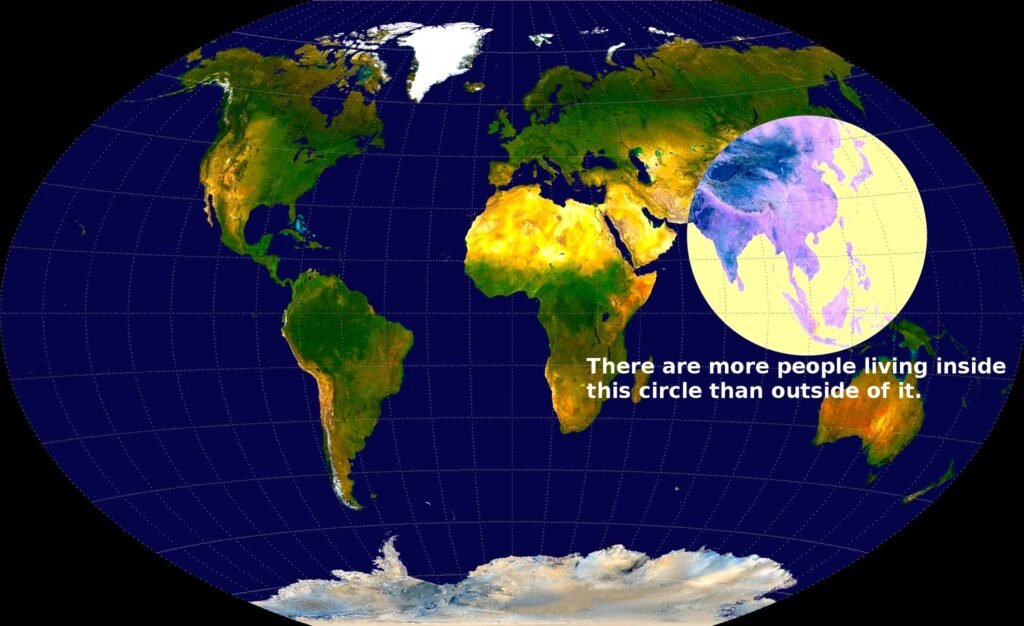
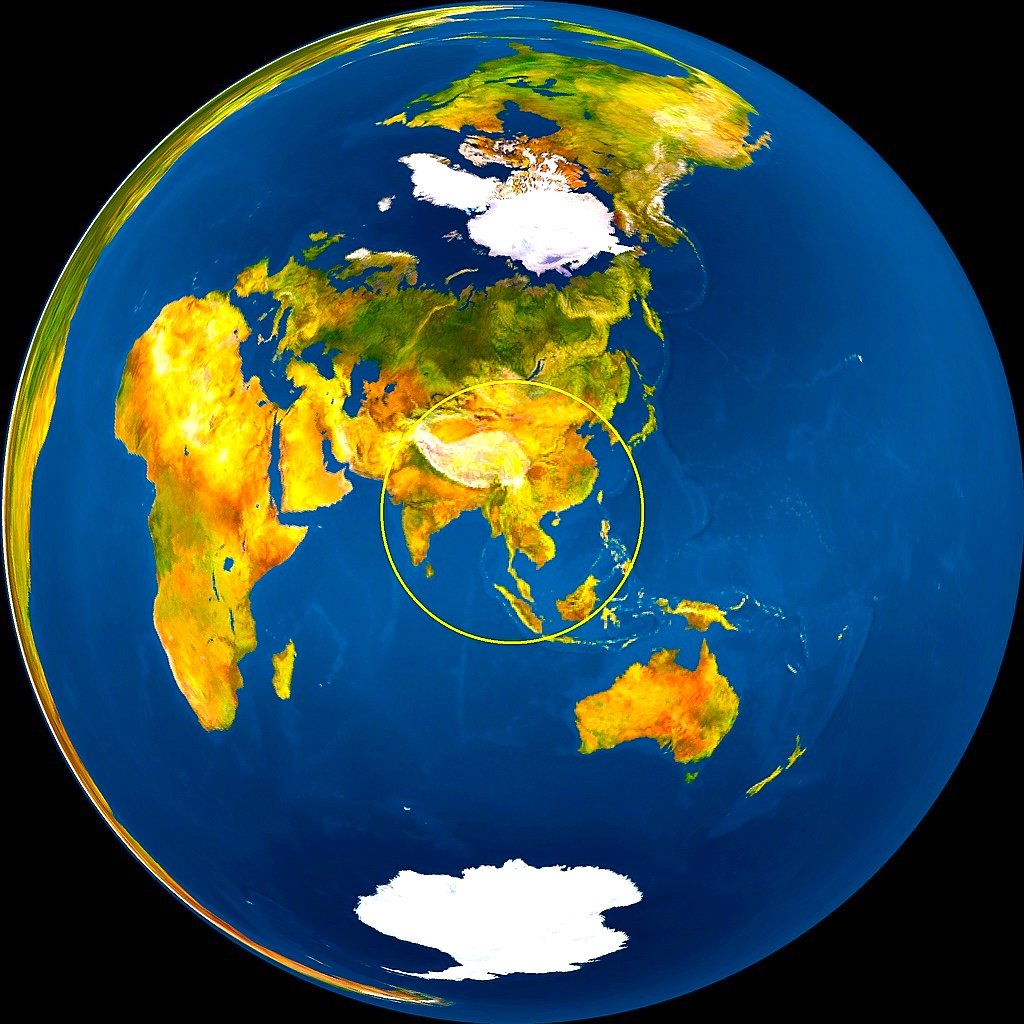
Look at a globe and pinpoint a specific geographical area spanning just one-tenth of the total surface. More than four billion people live inside that exact boundary, completely outnumbering the human population of the rest of the planet combined.
This massive demographic concentration started as a casual internet post and quickly evolved into a serious subject of academic study. The exact boundary contains the entirety of Taiwan, Nepal, Bangladesh, and Sri Lanka, alongside huge portions of China, India, and Indonesia.
A Viral Map That Challenged Demographics
In 2013, an American English teacher named Ken Myers posted an original map on the website Reddit. Using the username Valeriepieris, he drew a massive ring centered over the South China Sea. With a radius of roughly 4,000 kilometers (2,500 miles), the boundary encompassed slightly over half of the global population.
Media outlets quickly picked up the image, turning the Valeriepieris circle into a massive internet phenomenon. Myers utilized the Winkel tripel projection for his map, meaning his two-dimensional drawing did not actually correspond to a perfect sphere on a three-dimensional globe.
Refining the Exact Population Boundary
Researchers soon tested the viral claim using updated data and rigorous mathematics. In 2015, Singaporean professor Danny Quah calculated a much tighter boundary. He centered his proper sphere-adjusted circle over the township of Mong Khet in Myanmar.
Quah shrank the radius to just 3,300 kilometers (2,050 miles), claiming it was the smallest possible area containing half of humanity. Years later, mapmaker Alasdair Rae proposed the Yuxi Circle. Centered on Yuxi, China, this 4,000-kilometer (2,500-mile) radius held 4.32 billion residents, representing 55 percent of the global population at the time.
The Impact of the Asian Monsoon
This extreme density exists due to the specific physical geography of monsoon Asia. The Asian monsoon system delivers vast amounts of moisture across the region. Simultaneously, major river systems flow downward from the Tibetan Plateau, carrying fresh water into expansive fertile floodplains.
These environmental factors created the perfect conditions for intensive agriculture. Farmers leveraged the temperature and water supply to cultivate rice, millet, and wheat across immense stretches of land.
Millennia of Rapid Demographic Growth
The population density inside the Valeriepieris circle predates modern history. By the beginning of the Common Era, the Asian population already exceeded 100 million people. Historical records show that Asia held approximately 66 percent of the global population in the year 1000.
China and India alone accounted for half of all humans alive in 1500. During the twentieth century, these established agricultural centers experienced substantial demographic transitions, resulting in prolonged population spikes that cemented the extreme density visible today.