
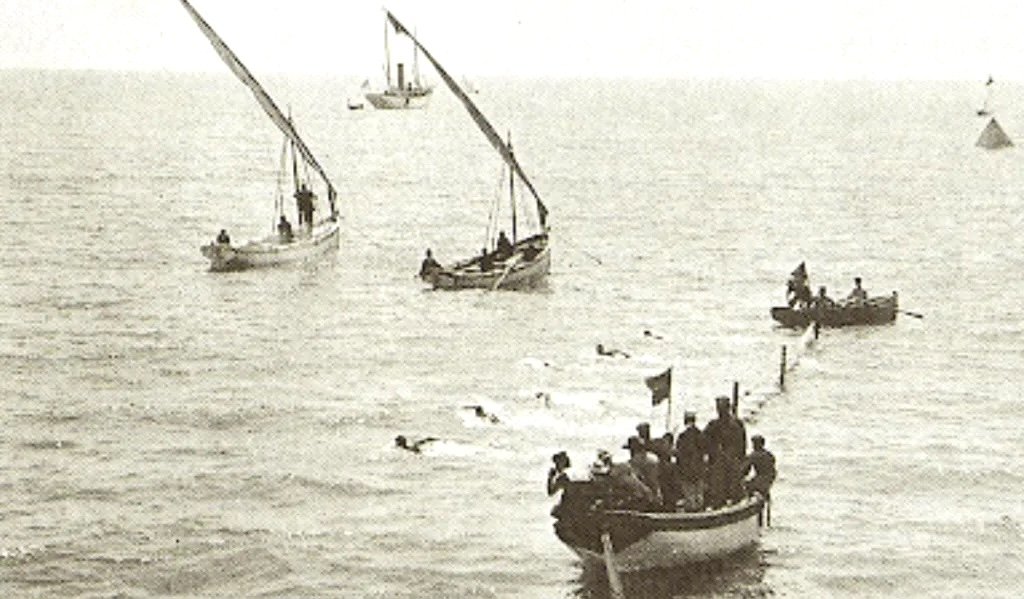
At the first modern Olympic Games in Athens, organizers staged a swimming competition that remains a total anomaly in sports history. Instead of opening the race to all qualified athletes across the globe, they restricted entry entirely to men holding one specific profession.
Competitors had to face freezing open waters and strong coastal currents in an event that would never be repeated in any future games. This was the men’s 100-metre (328-foot) freestyle for sailors, an official Olympic contest strictly limited to crew members of the Greek Royal Navy.
Setting the Stage in the Bay of Zea
Rather than building a heated, artificial swimming pool for the athletes, the 1896 Olympic organizers utilized the natural geography of Greece. All swimming events took place on April 11 in the Bay of Zea, a busy harbor located in the port city of Piraeus.
An estimated crowd of twenty thousand spectators gathered along the shoreline to watch. The water temperature hovered dangerously low, measuring around 13 degrees Celsius (55 degrees Fahrenheit). The sailors’ race was the second of four swimming events scheduled for that day. A total of eleven sailors from the Greek Royal Navy initially registered to take part in this highly exclusive 100-metre (328-foot) dash.
Dropped into Freezing Waters
The logistical setup for the race was entirely different from modern standards. There were no starting blocks, diving boards, or designated lanes. Officials transported the competitors out into the open bay on a wooden boat. They rowed the men out into the water, stopping exactly 100 metres (328 feet) away from the shoreline.
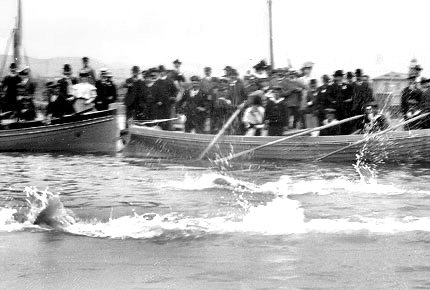
Once the boat reached the designated distance, the athletes had to jump into the frigid Mediterranean Sea. The race consisted of swimming directly back to the rocky shore while fighting the natural ocean tide. When the starting signal finally fired, only three of the original eleven registered sailors actually entered the freezing water to compete.
The Race to the Shoreline
Ioannis Malokinis, Spyridon Chazapis, and Dimitrios Drivas plunged into the cold sea and swam straight toward the finish line. Malokinis reached the shore first, securing the gold medal. He completed the 100-metre (328-foot) distance in two minutes and 20.4 seconds.
Chazapis arrived next to take the silver medal, and Drivas finished third to claim the bronze. The times recorded by the three sailors were significantly slower than those of the regular international competitors. Earlier that same afternoon, Hungarian swimmer Alfréd Hajós won the open 100-metre (328-foot) freestyle event with a time of one minute and 22.2 seconds. The sailors’ exclusive race remains a permanent, official part of the 1896 Olympic record books.