
Long before electricity powered our homes, people relied on a different energy source: dogs. Imagine a kitchen where a dog runs endlessly inside a wooden wheel just to cook dinner, or a tailor’s workshop where a canine drives heavy sewing machines.
For centuries, dogs hauled commercial carts, blew blacksmiths’ bellows, and operated industrial equipment. They even pulled weaponry onto the battlefield. This is the factual history of how dogs ran the machines of the past, until new technology pushed them out of the workplace.
The Kitchen Wheels and Dizzy Dogs
In 1500s Britain, a breed was developed for one purpose: running inside a suspended wheel to turn meat over a fire. In 1576, royal physician Johannes Caius classified them as the turnspit dog, or canis vertigus, which translates to “dizzy dog.” Kitchens often kept two turnspits to alternate shifts.
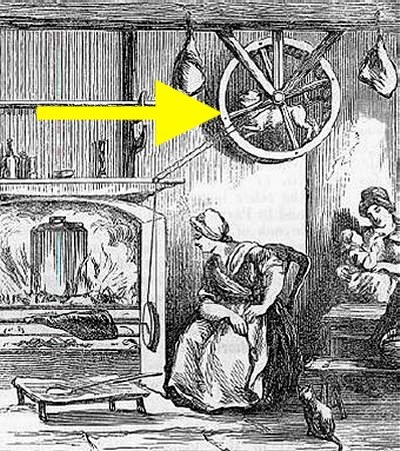
The dogs recognized the passage of time and jumped out of the wheel when their shift ended, forcing their partner to take over. When steam-powered roasting jacks entered the market, demand vanished. By the late 19th century, the breed went extinct. Today, only one stuffed specimen remains.
Four-Legged Factory Engines
Dog power extended far beyond the kitchen. Inventors built specialized engines to harness dogs for industrial labor. In Paris, the Richards Dog Engine utilized dogs walking on a wide belt to operate four heavy sewing machines simultaneously, manufacturing military uniforms.
In 1888, Heinrich Feldt of Hamburg patented a similar sewing-machine engine equipped with a brake shoe to control the animal’s speed. In Germany, this mechanical approach survived well into the 20th century. Records indicate that nail-makers used dogs running in wheels to operate forge bellows as late as 1930.
Hauling Milk and Ammunition
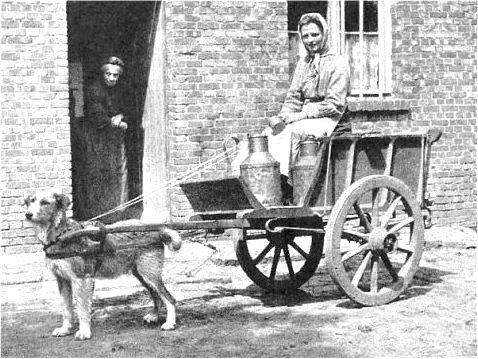
On the streets of Belgium and the Netherlands, large draught dogs were the primary motors for milk and bread delivery. Strong, heavily built dogs weighing up to 100 pounds pulled carts in parallel teams of up to five. Armed milk inspectors patrolled the streets with lactometers to ensure the milk carried by these teams was not watered down. The dogs’ strength was also utilized by the military.
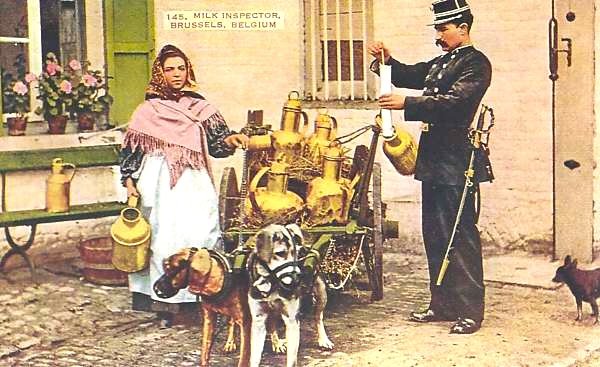
During World War I, the Belgian army conscripted milk-cart dogs to haul machine guns. Decades later, during the 1945 Battle of Berlin, dogs pulled trolleys loaded with ammunition and wounded soldiers.
The 1839 Ban and Experimental Vehicles
In Britain, dog hauling stopped with the 1839 Dog Cart Nuisance Act, banning cart dogs within 15 miles of London. Unable to feed animals that could no longer work, owners abandoned them. At least 150,000 dogs were destroyed in the first year, and child labor frequently replaced them.
Meanwhile, other countries continued experimenting with canine transportation. In 1875, a French builder created the Cynosphere, a dog-powered tricycle. In 1939, an 80-year-old Texan named Z. Wiggs took it a step further by inventing the Poochmobile, a highly engineered, dog-driven vehicle complete with headlights and a steering wheel.