
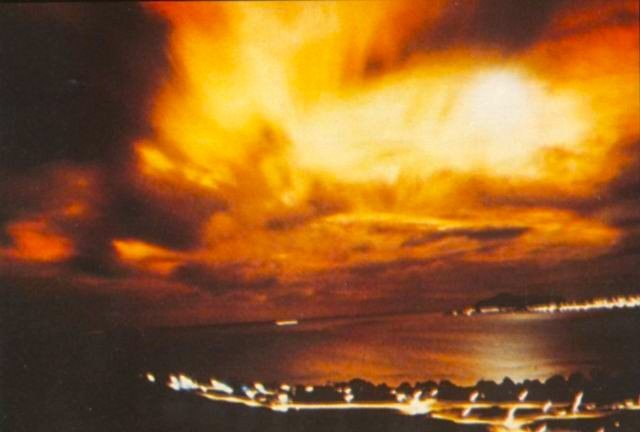
On July 8, 1962, streetlights went dark across Hawaii, burglar alarms blared, and phone service between islands suddenly died. The cause was not a storm or a power plant failure, but a 1.4-megaton nuclear warhead detonated 250 miles (400 kilometers) above the Pacific Ocean. Known as Starfish Prime, this United States space nuclear test lit up skies from New Zealand to Hawaii, crippled orbiting satellites, and drew uninvited Soviet ships to watch.
Launching a Thermonuclear Warhead Into Space
Conducted by the U.S. Atomic Energy Commission and the Defense Atomic Support Agency, Starfish Prime was the largest of five nuclear tests the United States carried out in outer space. The mission belonged to Operation Fishbowl, a high-altitude series started after the Soviet Union ended a three-year nuclear testing moratorium.
An earlier launch on June 20, 1962, failed when the Thor rocket engine stopped after 59 seconds, forcing range safety officers to destroy the missile at 30,000 to 35,000 feet (9,100 to 10,700 meters) and scattering radioactive debris over Johnston Atoll. On July 9 at 09:00:09 UTC—11:00:09 p.m. on July 8 in Honolulu—a second Thor rocket lifted off from Johnston Atoll and detonated 13 minutes and 41 seconds later, 19 miles (31 kilometers) southwest of the island.
An Unexpected Electromagnetic Pulse Hits Hawaii
The explosion generated an electromagnetic pulse (EMP) far stronger than scientists calculated, pushing measurement instruments off scale. Roughly 900 miles (1,450 kilometers) away in Hawaii, the surge knocked out about 300 streetlights, set off burglar alarms, and damaged a telephone microwave link, cutting calls between Kauai and the other Hawaiian islands. At Johnston Atoll, observers heard no sound from the blast, while Soviet scientific ships monitored the test from waters near the atoll and the Samoan Islands.
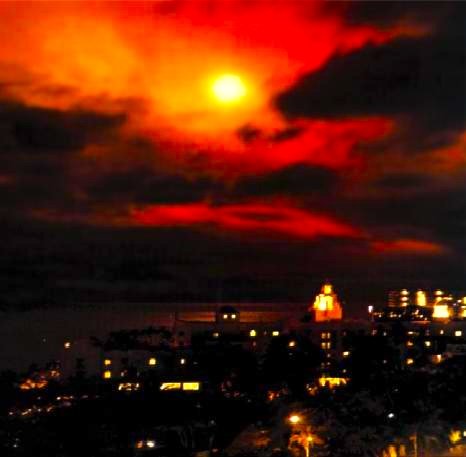
Artificial Auroras Light Up the Pacific Sky
Within seconds, the burst released roughly 10²⁹ electrons along Earth’s magnetic field lines, igniting artificial auroras across the Pacific. Witnesses saw white flashes, green fireballs, white rainbows, and deep red glows stretching from French Frigate Shoals to Tongatapu and Christchurch, New Zealand. In Hawaii, some hotels hosted rooftop “rainbow bomb” parties to watch the sky, while the Royal New Zealand Air Force used the overhead light during anti-submarine maneuvers.
Trapped Radiation Disables Orbiting Satellites
Many high-energy electrons remained trapped in Earth’s magnetosphere, intensifying the inner Van Allen radiation belt and creating artificial radiation belts that lasted five years. Over the next several months, this radiation damaged solar arrays and electronics on six or more low-Earth-orbit satellites, disabling AT&T’s commercial Telstar 1 and the United Kingdom’s first satellite, Ariel 1. In 1963, the United States and the Soviet Union signed the Partial Nuclear Test Ban Treaty, banning all above-ground nuclear tests.