
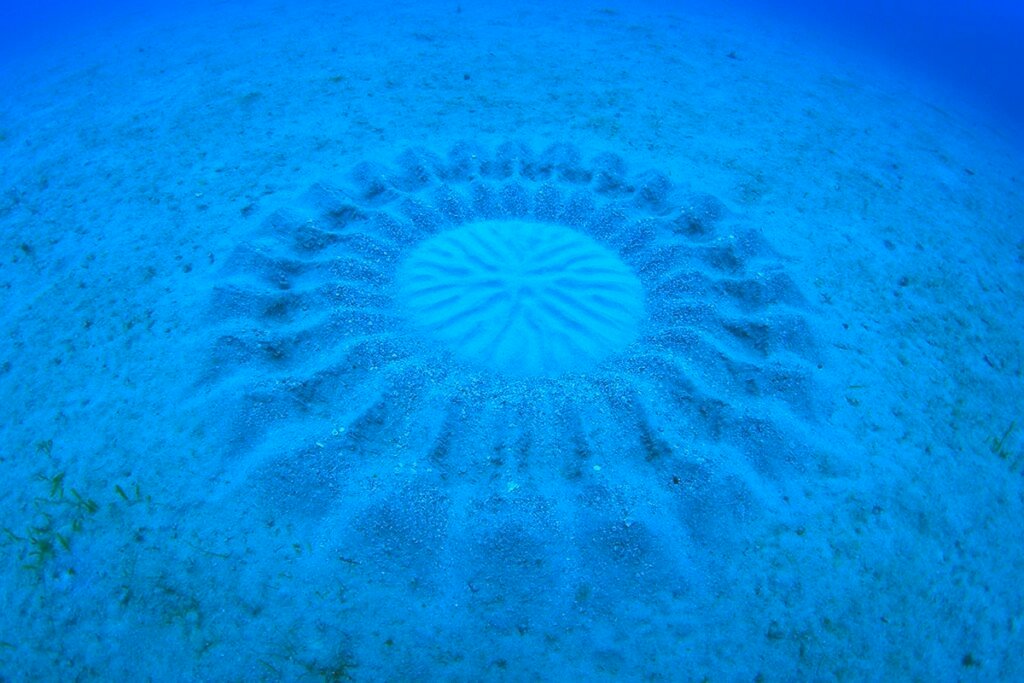
In 1995, divers off southern Japan found huge, symmetrical circles sculpted into empty stretches of ocean sand. Measuring roughly 2 meters (6.6 feet) across, the geometric rings vanished with the currents and reappeared in new spots without leaving a clue behind. For 16 years, nobody knew what created these underwater mystery circles, until cameras finally caught a tiny builder working day and night on the seabed.
Sixteen Years of Unexplained Seabed Circles
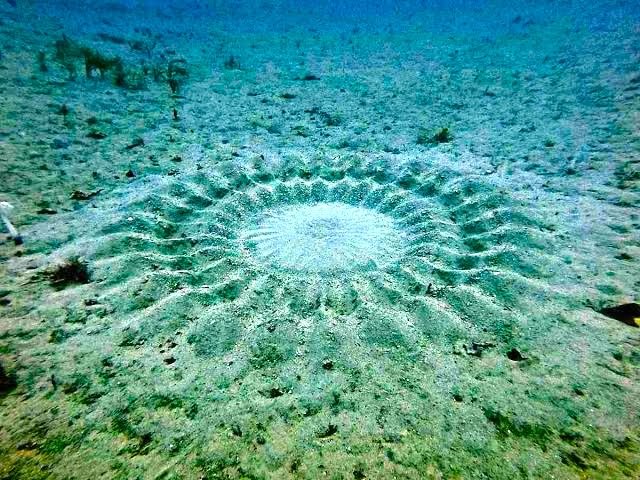
Divers first spotted the radial sand formations off the southern coast of Amami Ōshima in Japan’s Ryukyu Islands, lying at depths between 10 and 27 meters (33 and 89 feet). Each formation consisted of outer ridges and valleys ringing a sunken center filled with maze-like grooves. Against the flat sandy bottom, the shapes stood out clearly, earning the nickname mystery circles.
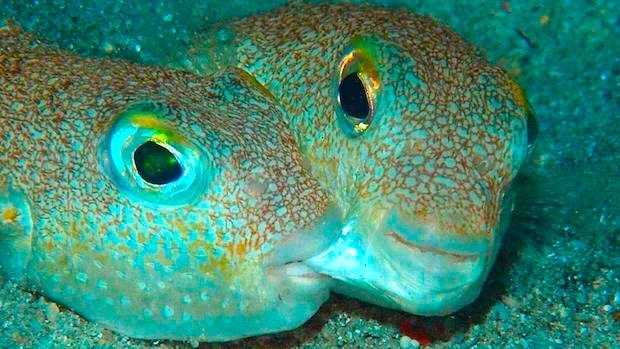
In 2011, underwater photographer Yoji Ookata teamed up with marine biologist Hiroshi Kawase and cameraman Kimiaki Ito to stake out the seafloor. Their footage exposed the sole architect: a male pufferfish measuring only about 12 centimeters (4.7 inches) long. In 2014, ichthyologist Keiichi Matsuura formally named the previously unknown fish Torquigener albomaculosus, the white-spotted pufferfish.
Seven Days of Nonstop Fin Work
Building a sand ring more than 16 times longer than his own body demands constant motion. Using only his fins, the male works around the clock for seven to nine days. He swims back and forth along straight radial paths, flapping his fins against the seabed to dig troughs and push sand into tall ridges.
Once the outer walls take shape, he moves fine sand particles into the center and pushes coarser grains outward. Before finishing, he gathers small bits of seashells and dead coral, placing them along the tops of the outer ridges.
How the Sand Rings Slow Ocean Currents
In 2013, Kawase and his colleagues published their study in Scientific Reports, showing how the structure behaves underwater. Field measurements revealed that the radiating ridges and valleys channel passing water toward the middle while cutting current speed at the center by nearly 25 percent. That drop in flow lets fine sediment settle in the middle and helps keep eggs from washing away.
Six Days of Guarding Before the Nest Vanishes
Once a circle is finished, females arrive to inspect the fine sand bed and shell-lined ridges. When a female chooses a nest, she lays her eggs in the center while the male fertilizes them, then swims off. The male stays behind to guard the eggs for roughly six days until they hatch. He stops maintaining the outer walls during that time, allowing ocean currents to flatten the circle back into plain sand before he leaves to build a new one elsewhere.