
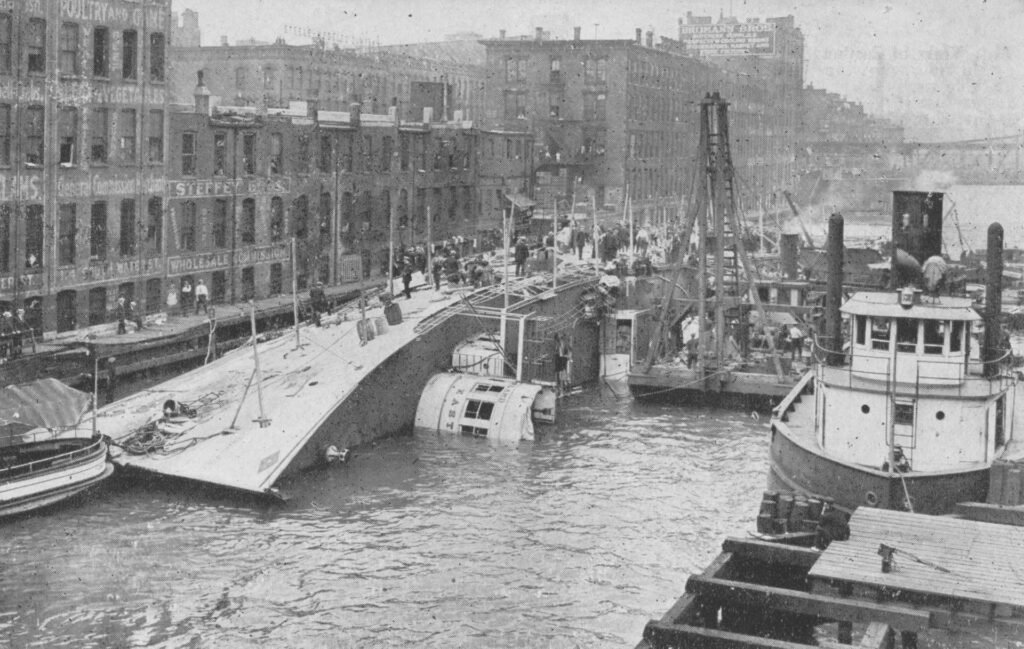
On July 24, 1915, 844 people died when a Great Lakes passenger steamer rolled onto its side in 20 feet (6.1 meters) of calm water while still tied to a Chicago River dock.
Chartered for a Western Electric company picnic, the SS Eastland capsized before leaving port—already unstable and weighted up high with concrete flooring and extra lifeboats added after the Titanic sinking. After killing hundreds of working-class immigrants and sparking decades of lawsuits, the salvaged ship later served in the U.S. Navy.
A Top-Heavy Steamer With a Troubled Record
Built in 1903 by Jenks Ship Building Company in Port Huron, Michigan, the 265-foot (81-meter) Eastland had stability trouble from her first season. Early modifications cut her hull draft and raised upper weight, and builder Sidney Jenks later testified that no formal stability test was ever run.
She nearly capsized in 1904 and listed 25 degrees in Cleveland in 1912. In 1914, new owners replaced forward dining room wood flooring with 2 inches (51 millimeters) of concrete, adding 15 to 20 short tons (13.6 to 18.1 metric tons). After the March 1915 Seamen’s Act passed following the Titanic sinking, owners mounted extra lifeboats and 37 life rafts at 1,100 pounds (499 kilograms) each on the upper deck to raise licensed capacity to 2,570 passengers.
Capsizing While Tied to the Wharf
On July 24, 1915, Western Electric chartered the Eastland to ferry Hawthorne Works employees from Cicero, Illinois, 40 miles (64 kilometers) across Lake Michigan to Michigan City, Indiana. Boarding began at 6:30 a.m. between Clark and LaSalle Streets, and over 2,500 passengers packed the ship by 7:15 a.m. As the vessel leaned away from the wharf, crewmen admitted water into her ballast tanks with little effect. At 7:28 a.m., she rolled completely onto her port side, resting on the river bottom 20 feet (6.1 meters) down.
Trapped Below Decks in Broad Daylight
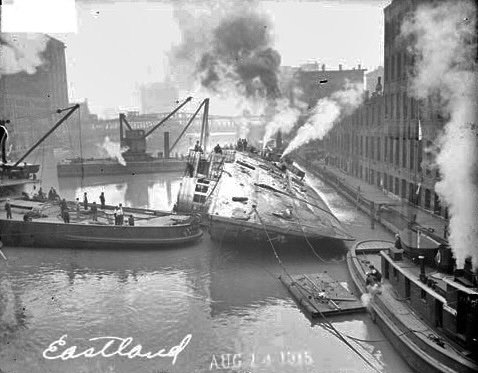
Bystanders threw boards into the river while the steamer Kenosha pulled alongside so survivors could leap onto her hull. Below decks, sliding pianos, tables, and rising water trapped hundreds who had gone inside out of the damp air. In all, 844 people died—about 70 percent under age 25—including 220 Czech immigrants and a Petoskey deckhand who drowned rescuing passengers. Bodies filled makeshift morgues at the Reid, Murdoch & Co. Building and the 2nd Regiment Armory.
Dismissed Charges and Service as USS Wilmette
A grand jury indicted four company officers, the captain, and the engineer, but a court refused extradition for lack of probable cause, and decades of civil lawsuits brought families little or no payout. Raised in August 1915, the Eastland was sold to the U.S. Navy in 1917, renamed USS Wilmette, and used as a Great Lakes training gunboat until scrapped in 1947.