On March 17, 1953, the United States broadcast a live nuclear explosion on national television for the very first time. While millions watched the 16-kiloton detonation of Upshot-Knothole Annie 65 miles (104.6 kilometers) northwest of Las Vegas, a parallel government project unfolded alongside the blast.
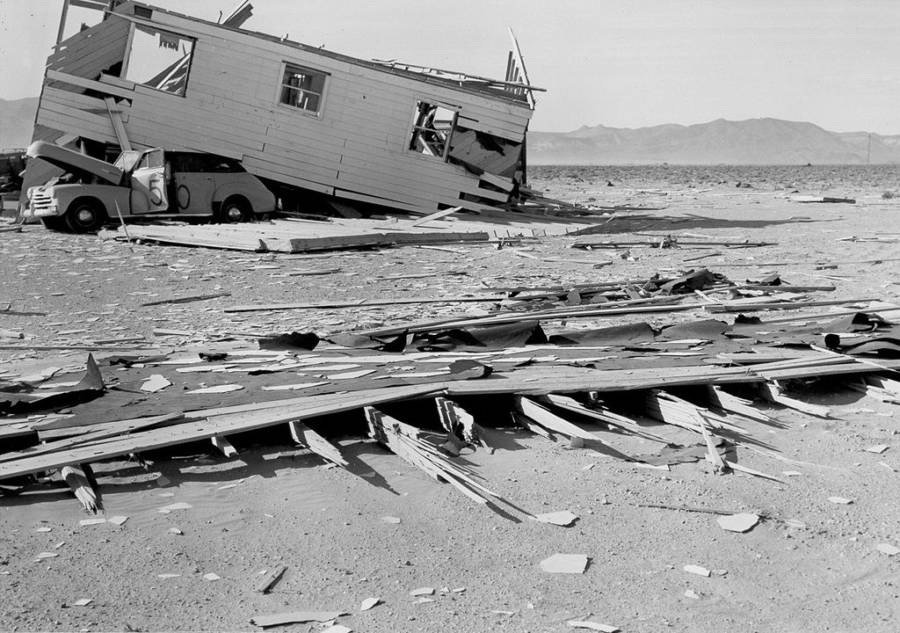
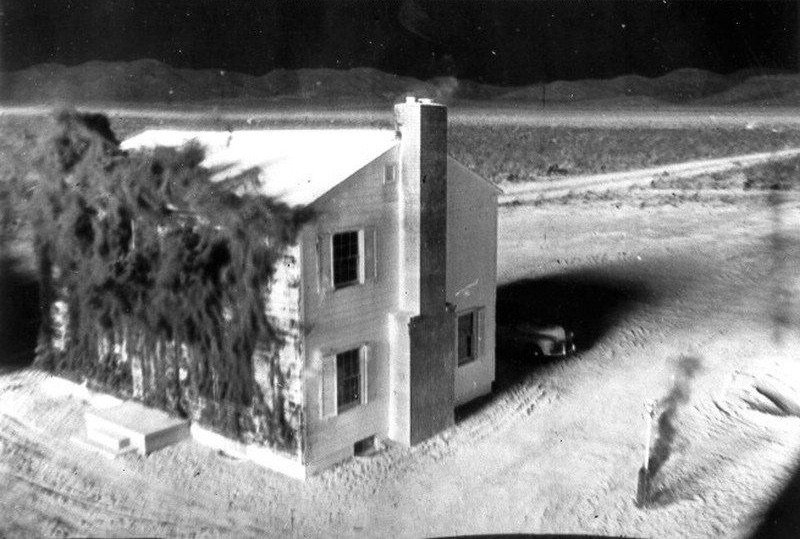
The Federal Civil Defense Administration orchestrated Operation Doorstep to record exactly what a nuclear explosion would do to a typical neighborhood. To find out, they built houses, parked cars, and populated the site with mannequins, deliberately subjecting a fake town to atomic destruction.
Building a Target for a 16-Kiloton Bomb
Officials constructed two wood-frame houses in the Nevada desert at precise distances from ground zero. They positioned the first house 3,500 feet (1,066.8 meters) from the blast center. The second house stood 7,500 feet (2,286 meters) away.
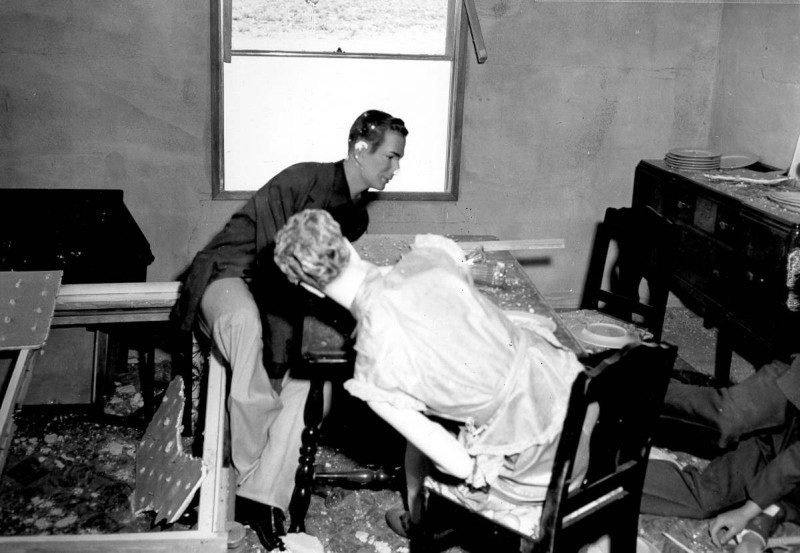
To simulate a populated neighborhood, crews scattered 50 automobiles throughout the test site and installed eight backyard bomb shelters. Inside the houses and cars, they arranged mannequins in everyday poses. They weighted the adult figures with sand to mimic human mass, leaving only the child mannequins unweighted.
Measuring the Atomic Destruction
Lacking the budget for advanced instruments to measure air pressure or wall displacement, researchers relied on film badges and fusion strips to record gamma radiation and extreme temperatures. When the bomb detonated, cameras captured the immediate physical effects.
The house located 3,500 feet (1,066.8 meters) away was completely obliterated in mere seconds. Data showed that anyone on the upper floors would have been killed by flying debris or severe radiation sickness, though the basement offered measurable protection. The second house at 7,500 feet (2,286 meters) suffered heavy charring and structural damage but remained standing.
The Survival of Cars and Shelters
The automobile tests yielded specific data regarding blast survival. The administration concluded that a family car could offer safety outside a ten-block (roughly 1 mile or 1.6 kilometers) radius of a similar explosion. However, this required leaving the car windows rolled down to prevent the sudden pressure wave from caving the roof in on the occupants.
The backyard underground shelters performed the best out of all the tested structures, providing the highest level of protection from both the blast wave and the resulting radiation.
Publishing the Results
Later that same year, Federal Civil Defense Administrator Val Peterson released the findings in a public booklet. The government sold this detailed 1953 report for 25 cents. It contained before-and-after photographs of the blast zone, featuring images of the scorched mannequins amid the structural wreckage.
The publication distributed the physical results of Operation Doorstep directly to households across the country. Citizens could purchase this visual proof of the bomb’s destructive capabilities for less than a dollar, seeing exactly what happened to the test structures.