
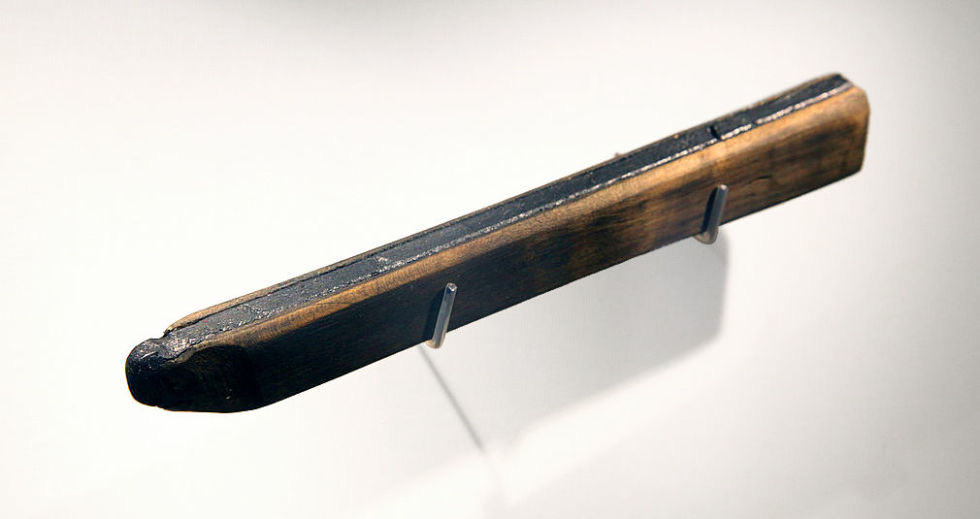
Centuries ago, a tradesman working on a timber-framed house accidentally left behind a small wooden tool. For more than 300 years, this object sat hidden in the dark attic of a building in Langenburg, Germany. It was not until the 1960s that restoration workers uncovered this lost item tucked between the heavy wooden beams.
What they found was the oldest known surviving wood-cased pencil in existence. This small artifact from the 1630s remained completely undisturbed through centuries of changing weather. The discovery established a physical timeline regarding the manufacturing of writing instruments.
The Discovery Inside a Swabian Attic
During the 1960s, workers began restoring a 17th-century house in the town of Langenburg, located in the Swabia region of Germany. The building was originally constructed around the year 1630. While dismantling and repairing the roof structures, the crew found a flat, rudimentary pencil resting on one of the wooden beams.
Historians determined that a carpenter dropped or forgot the tool during the initial construction of the house. The dry environment of the attic kept the wood and the graphite core perfectly intact for over three centuries. This specific find confirmed early pre-industrial pencil use in Europe.
The Design and Construction of the Tool
The construction of this 17th-century writing instrument differs from modern cylindrical pencils. It was made of lime wood, crafted using the standard hand-carving methods of the era. The tool features a flat shape, which prevented it from rolling off slanted surfaces like roofs or workbenches.
The graphite core is thick and wide, specifically designed for making bold, dark strokes on rough timber rather than fine lines on paper. Early pencil makers created these tools by carving two separate wooden halves, inserting a solid slab of mined graphite, and gluing the pieces together.
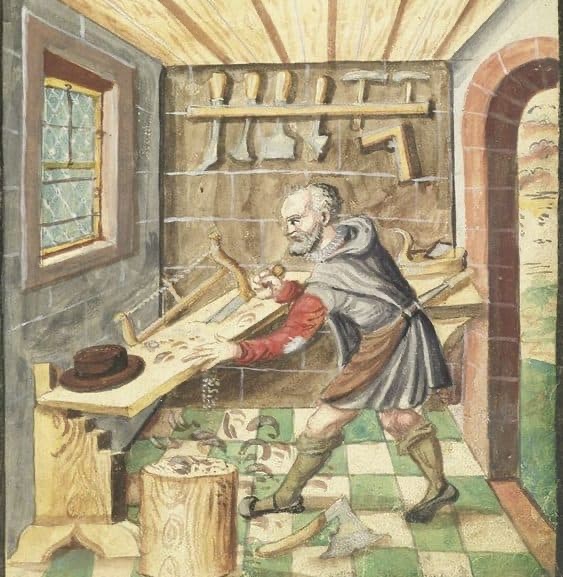
The Evolution of Pencil Manufacturing
When the Langenburg pencil was made, chemistry was in its infancy. People mistakenly believed the dark writing material was a form of lead. It was not until 1795 that French scientist Nicolas-Jacques Conté developed the modern method for producing pencil cores. Conté mixed powdered graphite with clay and roasted the mixture in a kiln at 1,900 degrees Fahrenheit (1,038 degrees Celsius).
This process allowed manufacturers to control the hardness of the core. The Swabian carpenter pencil predates Conté’s method by more than 160 years, containing a pure, unbaked graphite slab rather than a clay mixture.
The Artifact’s Current Location
In 1994, the historic Langenburg pencil was acquired by the Faber-Castell private collection. It is now officially preserved at the company’s headquarters in Stein, Germany. The company, which is one of the oldest manufacturers of writing instruments in the world, displays the artifact to show early European craftsmanship. It rests securely in a protective case, remaining physically identical to the day the carpenter left it behind in the 1630s.