
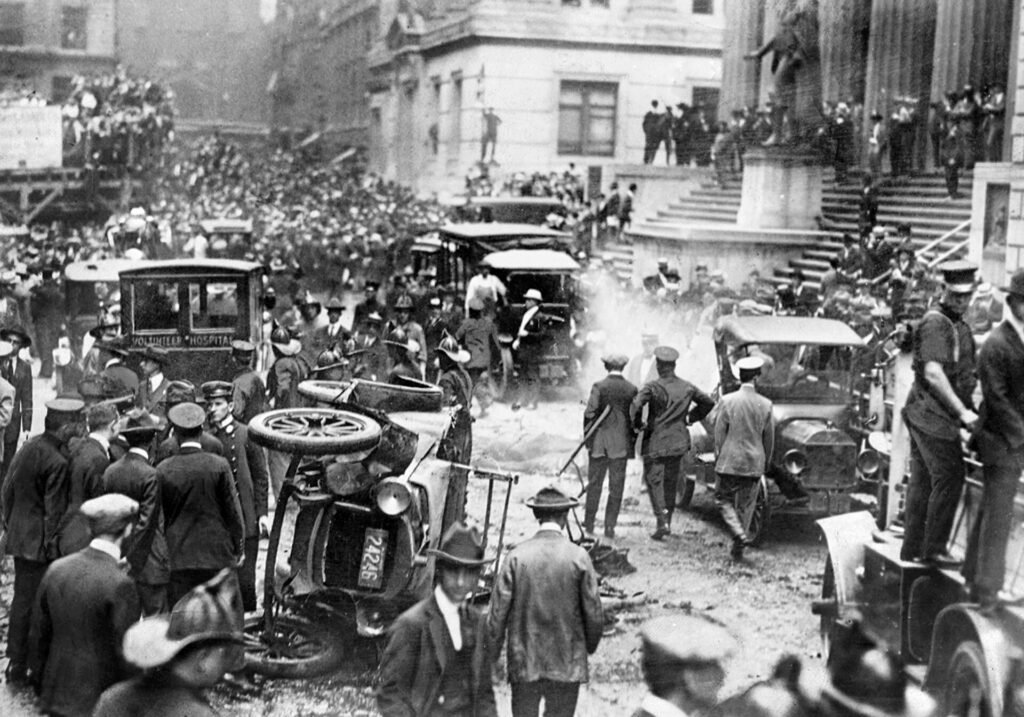
On September 16, 1920, the bustling lunch hour in New York City’s Financial District was violently interrupted by a massive explosion that killed 38 people and injured hundreds.
A horse-drawn cart packed with dynamite and heavy iron weights detonated directly outside the world’s most powerful banking institution. To this day, the perpetrator of this devastating attack remains unidentified, making it one of the deadliest unsolved crimes in the country’s history.
A Deadly Delivery in Broad Daylight
At exactly noon, an unidentified driver steered a horse-drawn cart into the heart of Wall Street, stopping in front of the J.P. Morgan Bank at 23 Wall Street. The driver abandoned the cart, slipping away into the crowded streets. Inside the wagon sat 100 pounds of dynamite concealed alongside 500 pounds of cast-iron weights.
One minute later, the explosives detonated.
The blast instantly killed 30 people, including clerks and brokers on their lunch break. The sheer force of the explosion knocked a trolley car off its tracks two blocks away. Eight more victims died from their injuries in the following days, bringing the death toll to 38, with an additional 143 people suffering severe wounds from the flying shrapnel.
The Destroyed Clues
Immediately following the attack, police and financial workers commandeered passing cars to rush the injured to nearby hospitals. The New York Stock Exchange suspended trading for the day. However, in an effort to resume business operations quickly, city officials ordered cleaning crews to clear the streets overnight.
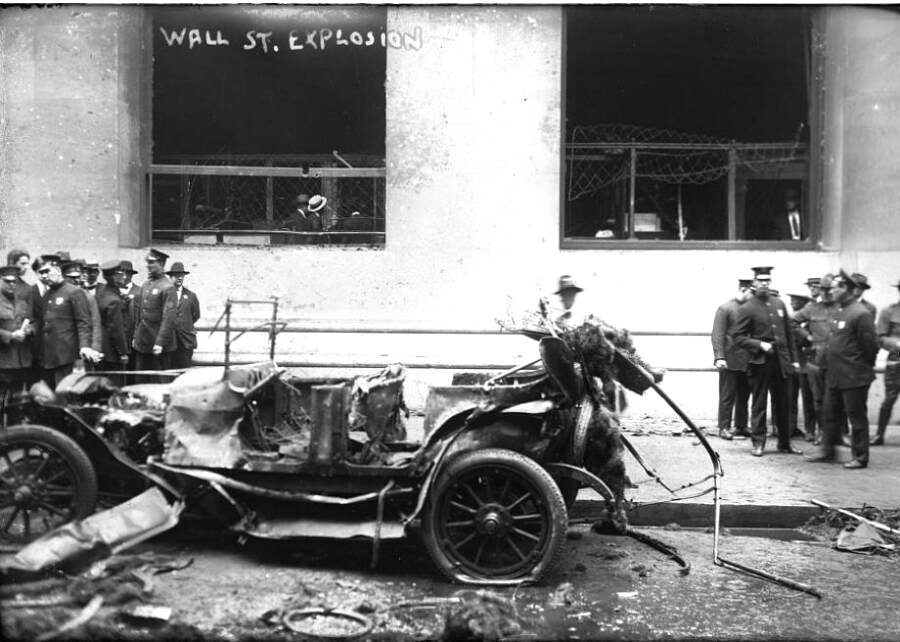
This rapid cleanup accidentally destroyed crucial physical materials. Shrapnel, cart fragments, and other debris that could have provided investigative leads were swept up and discarded. Investigators attempted to trace the horseshoes found at the scene, hoping to locate the blacksmith who made them, but this lead went cold. No group claimed responsibility for the explosion, leaving authorities with few concrete details.
Suspects and Theories
Early theories varied wildly. Some investigators suspected the explosion was a diversion for a botched robbery at the nearby Sub-Treasury building, where $900 million in gold bars was being transported.
The FBI eventually took over the case and focused on radical political groups. Just a year prior, followers of Italian anarchist Luigi Galleani had executed a nationwide mail bombing campaign. Investigators suspected these “Galleanists” were responsible, but they lacked hard facts to make an arrest.
The Anarchist Who Got Away
Decades later, historians examining the case files identified a prime suspect: Mario Buda, an associate of the Galleanists. Police files suggested Buda had rented the specific horse and cart used in the bombing.
Furthermore, Buda was in New York City on the day of the attack and immediately fled to Italy shortly after. While acquaintances later claimed he privately admitted to the crime, these statements remained hearsay. Buda was never formally charged or extradited, leaving the case officially unresolved.