
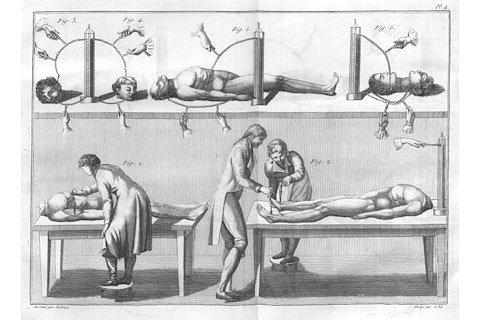
In early 19th-century London, a crowd gathered in a medical theater to watch a dead man open his eye. An Italian physicist stood over the corpse of an executed criminal, applying metal probes connected to a crude battery. As electric currents surged through lifeless flesh, the dead man’s jaw quivered and his limbs thrashed.
The audience watched in horror, believing they were witnessing the dead return to life. This gruesome demonstration would become the talk of Europe and ultimately spark the creation of the most famous science fiction monster in literary history.
From Frogs to Farm Animals
Giovanni Aldini was born in Bologna in 1762. He spent his early career assisting his uncle, Luigi Galvani. Galvani had famously discovered that applying electrical currents to the severed legs of dead frogs caused the muscles to violently twitch. Aldini adopted his uncle’s theories but sought larger subjects.
He began applying electrical impulses to the corpses of sheep, pigs, and oxen. During these public demonstrations, the battery caused the animals’ heads to shake and their tongues to roll out. Aldini soon exhausted the potential of animal testing and shifted his focus.

The Search for Intact Human Subjects
Finding human corpses in early 1800s Italy was simple due to frequent public executions. Criminals at the Piazza Maggiore were beheaded. Aldini quickly discovered a major flaw in using these bodies. Beheaded corpses were completely drained of blood. Without fluid in the veins, the electrical currents had no conductive path.
Aldini needed a freshly killed corpse with an intact circulatory system. Because England executed criminals by hanging at the gallows, Aldini packed his equipment and traveled to London.
The George Foster Experiment at Newgate
In 1803, Aldini received the freshly hanged body of a criminal named George Foster. The experiment took place at the Royal College of Surgeons. Aldini attached metallic probes to Foster’s body and powered up his battery. The results shocked the attending doctors. Foster’s facial muscles horribly contorted.
His left eye opened. As the electrical application continued, the corpse raised and clenched its right hand. Foster’s legs were set into intense motion, and the body even appeared to inhale. The battery eventually drained, leaving the corpse motionless once again.
Sparking a Science Fiction Masterpiece
Newspapers like The Times immediately published reports of the demonstration. The story spread rapidly across English scientific and social circles. The tale of electricity manipulating a dead body reached the ears of a young Mary Shelley. Years later, when she sat down to write her famous 1818 novel, galvanism was a major topic of discussion in her social circle.
She wrote about a scientist named Victor Frankenstein who used electricity to animate dead tissue. The fictional doctor shared striking similarities in methods with the very real Giovanni Aldini.