
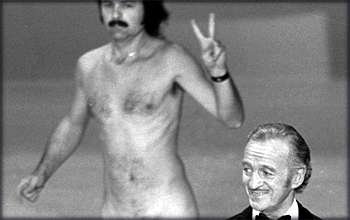
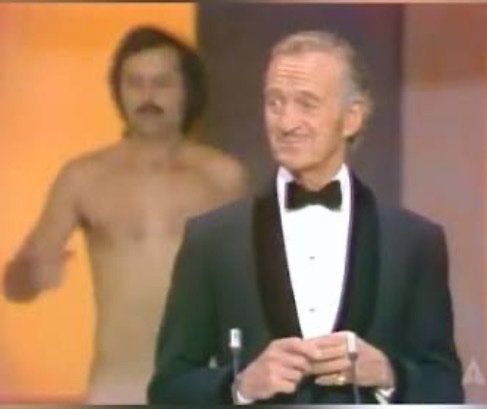
On April 2, 1974, an estimated 85 million television viewers watched live as a naked man dashed across the stage of the 46th Academy Awards. Flashing a peace sign as he ran behind presenter David Niven, the streaker instantly became a pop culture phenomenon.
Yet, the man who interrupted the biggest night in Hollywood, Robert Opel, lived a life far more complex than his brief moment of televised notoriety. From working as a political speechwriter to running for the United States Presidency, his story is one of the most unusual chapters of the 1970s.
From Speechwriter to Academy Awards Streaker
Born Robert Oppel in East Orange, New Jersey, he dropped the second “p” in his last name to distance himself from his Pittsburgh family and avoid causing them embarrassment through his activism. Before making headlines at the Dorothy Chandler Pavilion, Opel built a surprisingly conventional early career. He served as a speechwriter for California Governor Ronald Reagan and taught English as a second language for the Los Angeles Unified School District.
To execute his run, Opel posed as a journalist to bypass security. The show’s business manager, Robert Metzler, noted evidence suggesting the event was orchestrated by producer Jack Haley Jr. as a stunt, pointing out that Opel had to cut through an expensive background curtain to reach the stage. Following the broadcast, the school district fired Opel from his teaching position.
A Campaign for the US Presidency
Opel capitalized on his Oscars fame to enter national politics. In 1976, he launched a campaign for the United States Presidency. His platform leaned into his streaking stunt and the political climate following President Richard Nixon’s resignation, utilizing the campaign slogans “Nothing to Hide” and “Not Just Another Crooked Dick.” He also ran his own photography business, Ideas Photographic, serving clients like The Advocate and Finger magazine.
Fey-Way Studios and a Tragic End
In March 1978, Opel opened Fey-Way Studios at 1287 Howard Street in San Francisco. The gallery operated as a prominent venue for gay male art. Opel brought national attention to artists including Robert Mapplethorpe and Tom of Finland, alongside exhibits by Rex and Dom Orejudos.
On the night of July 7, 1979, Opel was hosting friends inside his studio when two armed men, Maurice Keenan and Robert E. Kelly, entered. The intruders demanded money and drugs. Opel denied having money and attempted to force them out. The men shot Opel at close range, and he was pronounced dead at 10:40 p.m. at the age of 39. Kelly received a sentence of 25 years to life, while Keenan was sentenced to death, later commuted to life imprisonment.