
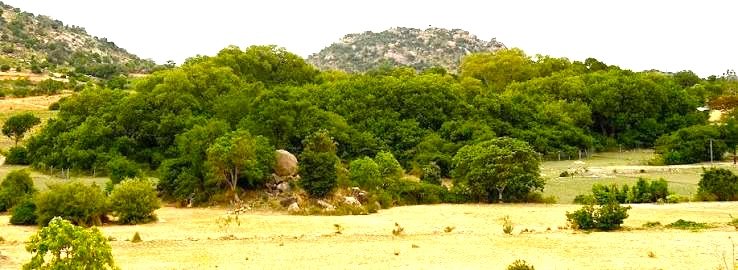
Located about 180 kilometers (112 miles) from Bangalore in the dry landscape of Andhra Pradesh, India, a sprawling canopy stretches across 19,107 square meters (4.72 acres) of land. To a passing observer, the dense collection of over 4,000 thick wooden pillars looks exactly like a large woodland grove.
However, this massive structure is entirely a single banyan tree known as Thimmamma Marrimanu. Holding a 1989 Guinness World Record for its massive size, the sprawling plant hides an active temple complex and a dramatic fifteenth-century origin story deep within its labyrinth of roots.
The Anatomy of a Strangler
The Ficus benghalensis begins its life not in the dirt, but high in the branches of other trees. As an epiphyte, it drops vine-like roots down toward the forest floor. These roots eventually anchor into the ground, absorbing water and nutrients while thickening into massive pillars that completely envelop the original host.
Thimmamma Marrimanu has utilized this exact process to expand its massive footprint. Despite heavy damage from severe cyclones and extended droughts over the centuries, the plant continues its outward expansion, directly aided by tiny fig wasps that pollinate its small red fruits.
The Fire of 1433
The origin of this specific giant traces back to 1433. Historical accounts and local beliefs state that a woman named Thimmamma threw herself onto her husband’s funeral pyre after he succumbed to leprosy. According to the accounts, one of the wooden poles supporting that exact pyre took root in the soil and sprouted into the banyan.
In 2001, an excavation team dug at the center of the massive root system and unearthed old bangles and jewelry. Following this physical discovery, regional priests and officials ordered the construction of a permanent temple directly over the funerary monument.

Shrines Hidden in the Wood
Because of its immense scale, the tree houses an entire religious complex within its living wooden walls. Pilgrims remove their shoes before entering the canopy. Inside, they bow to a statue of Nandi the bull and walk exactly five times to the right around the burial monument.
Visitors frequently tie saffron-colored ribbons to the hanging roots, specifically hoping to gain fertility. During the annual Maha-Shivaratri festival, thousands of people crowd beneath the leaves to pray and physically hug the massive trunks.
Engineering Continued Growth
Freelance journalist Regret Iyer first brought the tree to global attention, leading to its official world record documentation. Today, keeping the massive structure alive requires direct human intervention. The high volume of festival visitors causes physical damage to the intricate root system.
To counteract this, local forestry department workers routinely guide new hanging vines into hollow bamboo poles filled with nutrient-rich soil. They also install permanent stone plinths beneath heavy damaged branches, physically supporting the canopy so the 550-year-old organism can continue spreading outward.