
Roughly 580 million years ago, strange biological structures appeared in the cold, deep-ocean environments of the Earth. These life forms possessed no mouths, no guts, and lacked any apparent reproductive organs. They survived in complete darkness below the lowest levels of sunlight penetration.
Paleontologists call them rangeomorphs, a key part of the Ediacaran biota that dominated the planet for 30 million years before vanishing entirely 538.8 million years ago. Despite detailed fossil evidence from sites like Newfoundland, scientists still struggle to determine whether these ancient entities were animals, fungi, or something entirely separate from anything alive today.
Fractal Anatomy Built From Branching Tubes
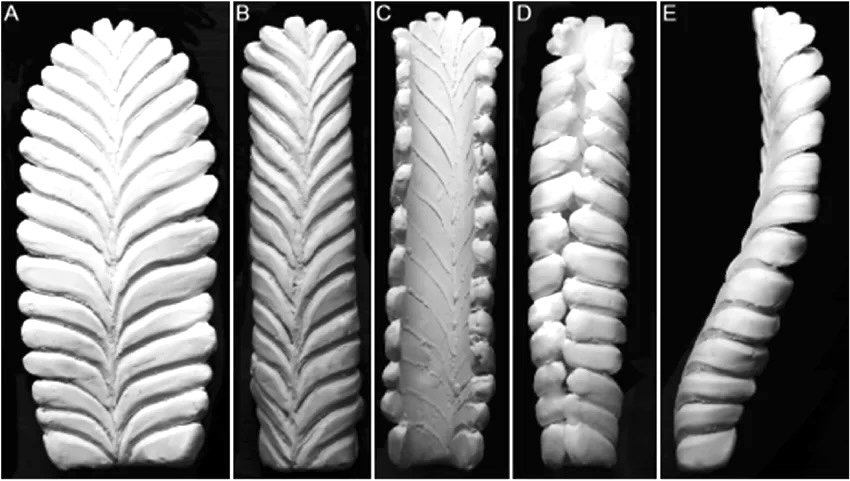
Rangeomorph fossils look roughly like fern fronds or feathers arranged around a central axis. Their physical structure was entirely fractal and self-similar. The main body consisted of branching fronds, each measuring a few centimeters long. These sections further branched into tiny frondlets.
The entire organism was constructed from a network of tubes held up by a semi-rigid organic skeleton. Because every small section repeated the exact shape of the whole, this repetitive developmental pattern provided an unusually massive surface area for every unit of body volume.
Feeding Through Osmosis on the Sea Floor
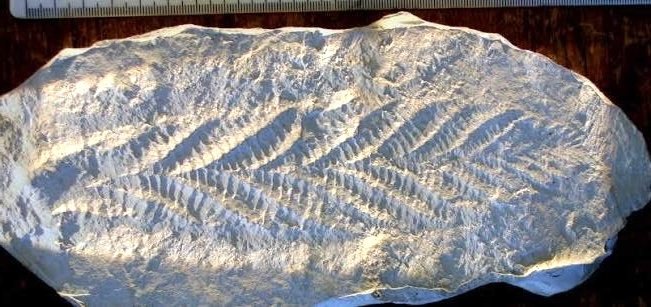
Most of these organisms attached themselves to the sea floor using a stalk ending in a circular holdfast. Others, like the spindle-shaped genus Fractofusus, simply lay flat on the ocean sediment. Since they lived in abyssal marine zones devoid of sunlight, photosynthesis was physically impossible. Without a mouth or digestive system, they had to absorb nutrients from the seawater. Paleontologists hypothesize that their extensive fractal surface area allowed them to concentrate nutrients through direct osmosis. Only osmotrophic bacteria feed this way today.
Reproducing Like Modern Strawberry Plants
Fossil assemblages in Newfoundland and the United Kingdom show that rangeomorphs often lived in large groups. Evidence reveals they could spread across the sea floor using specialized methods. Some genera utilized filaments or stolons up to four meters long that ran through the bacterial mats on which they lived.
Analysis of Fractofusus indicates a two-step reproductive cycle. First, an individual set a tissue particle loose in the ocean currents to land and grow into a new grandparent organism. This grandparent then spread rapidly by extending stolons to form a surrounding cluster of smaller parent and child fronds, identical to how modern strawberry plants spread using runners.
The Unresolved Evolutionary Puzzle
Early researchers initially classified these organisms as sea pens. Closer examination of well-preserved specimens of the genus Charnia proved that their anatomy and growth patterns were fundamentally different. While their fractal construction suggests a shared biological ancestor, their exact classification remains uncertain.
A 2021 scientific analysis of Charnia concluded that rangeomorphs were early diverging eumetazoans that were not closely related to any living animal group. Today, they are grouped purely by their physical appearance as a form taxon until researchers can definitively map their genetic origins.