
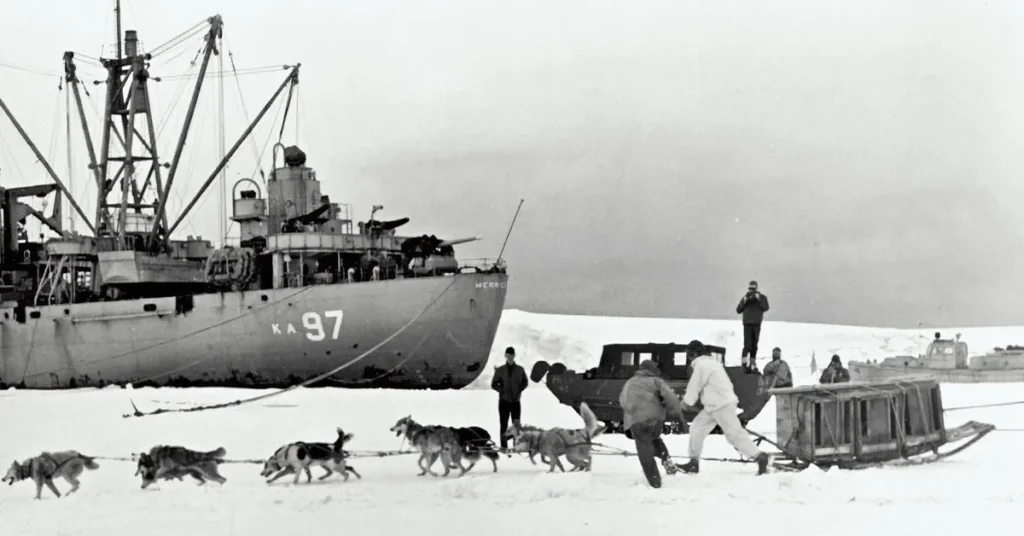
In 1946, the United States military dispatched 70 ships and over 4,700 personnel to the most unforgiving environment on Earth, carrying both official objectives and highly classified orders. Announced in August of that year, Operation Highjump sent troops into the freezing Antarctic in the shadow of a brewing Cold War.
Officially, this massive deployment was a training exercise to test equipment in frigid conditions. Behind closed doors, the Navy sought to stake territorial claims and prepare for potential Soviet attacks over the North Pole. The three-month mission brought triumphs, fatal disasters, and lingering conspiracy theories.
Launching Naval Task Force 68
Led by Rear Admirals Richard E. Byrd and Richard H. Cruzen, Task Force 68 arrived in the Antarctic in December 1946. Admiral Chester Nimitz stated the primary goal was training personnel and establishing air bases in extreme conditions. The military also faced political pressure.
The Navy wanted to prove its value to President Harry Truman during a time of post-war budget cuts. By January, the crew found a suitable site near the Bay of Whales. They unloaded snow vehicles and immediately began constructing Little America IV, a temporary base equipped with tents, huts, and runways.
Fatal Crashes On The Ice
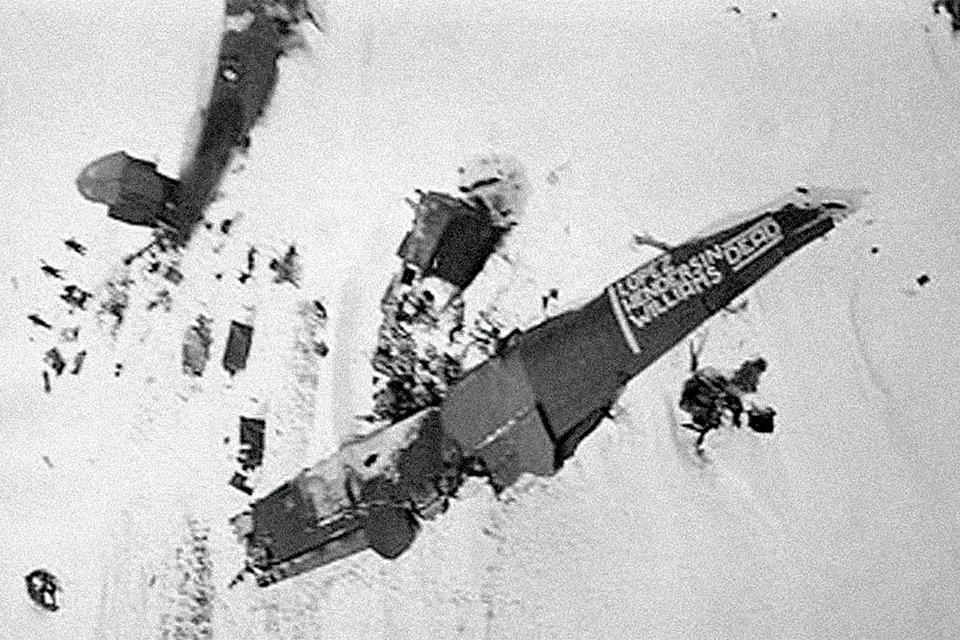
The severe polar climate quickly claimed lives. On December 30, a Martin PBM-5 aircraft named George 1 crashed on Thurston Island. Three men, Maxwell A. Lopez, Wendell K. Henderson, and Frederick W. Williams, died in the wreckage. Six crew members survived the impact and endured 13 days on the ice before being rescued.
Helicopters proved highly efficient but extremely dangerous due to ice accumulating on the rotor blades. During one reconnaissance flight, a helicopter returning to the USS Pine Island plummeted into the freezing sea. Rescue teams managed to pull the two men aboard from the water.
Massive Mapping And An Abrupt Exit
Despite the hazards, the expedition achieved massive geographical surveys. Task Force 68 collected soil and water samples and discovered a large coal deposit. Aircraft completed 28 flights, capturing 70,000 photographs and mapping over 1.5 million square miles of the frozen continent. Suddenly, in February 1947, the Navy ended the operation. While officials declared it a success, many participants felt confused.
Pilot Conrad Shinn later stated they lacked clear objectives and did not fully understand what they were looking at. Military photographers filmed the entire deployment, resulting in the documentary The Secret Land, which won an Academy Award.
Cold War Pressures And Conspiracy Theories
The rushed timeline and classified orders fueled immediate public speculation. Conspiracy theorists suggested the Navy was actually hunting for secret Nazi bases or making contact with aliens. Recent claims assert the military was photographing a supposed ice wall or a hidden civilization.
None of these rumors have ever been proven. Following Operation Highjump, the international community pushed to keep the region peaceful. In 1959, nations signed the Antarctic Treaty, officially preventing the militarization of the continent and dedicating the territory to science.