
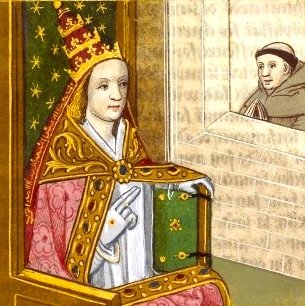
During the Middle Ages, a shocking legend emerged that a woman named Joan successfully disguised herself as a man, rose through the Catholic hierarchy, and ruled as Pope for over two years. Her reign supposedly ended in chaos when she unexpectedly gave birth during a papal procession.
While most modern scholars consider her story a myth, it was widely accepted as historical fact for centuries. This is the timeline of the legend of Pope Joan, a captivating tale that continues to fascinate historians and novelists alike.
The Birth of a Papal Legend
The earliest mention of a female pope appeared in the Chronica Universalis Mettensis, written by the Dominican Jean de Mailly in the early 13th century. In his version, an unnamed woman disguised as a man became Pope in 1099. Her secret was revealed when she gave birth while mounting a horse, leading to her being dragged and stoned to death by the people.
Later in the 13th century, Martin of Opava introduced the most popular version of the legend, naming her John Anglicus of Mainz and placing her reign between Leo IV and Benedict III in the 850s. According to Martin, she became pregnant by her companion and gave birth during a procession from St. Peter’s to the Lateran.
A Widespread Belief
From the mid-13th century onward, the story of the female pope was widely disseminated and believed. Joan was used as an exemplum in Dominican preaching and figured in books published in the Papal States. The Siena Cathedral featured a bust of Joan among other popes from 1263 until 1600. Legends associated with her reign suggested that subsequent popes were subjected to a physical examination to prove their sex.
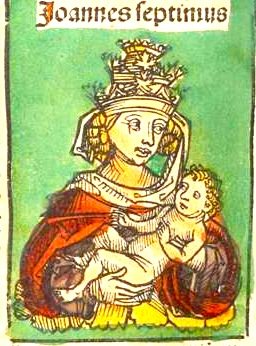
The Deconstruction of a Myth
The legend of Pope Joan was generally accepted until the 16th century. In 1587, Florimond de Raemond published a tract analyzing the tale, and in 1601, Pope Clement VIII declared the legend untrue. The mid-17th-century Protestant historian David Blondel effectively demolished the myth through detailed analysis, proving the chronological impossibility of her reign. Modern scholars echo this, noting that enemies of the 9th-century papacy never mentioned a female pope.
A Lasting Cultural Impact
Though dismissed by scholars, Pope Joan remains a popular subject in fiction. Her story has inspired plays, novels, and films, including Emmanuel Rhoides’s 1866 novel The Papess Joanne and Donna Woolfolk Cross’s 1996 historical romance Pope Joan. Most recently, Andrea Balzola’s theatrical piece La Papessa was performed in Italy in 2025, and an English version premiered at the Prague Fringe Festival in May 2026.