
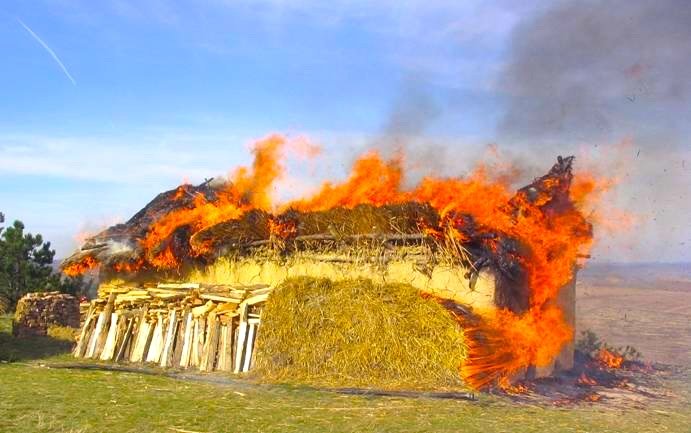
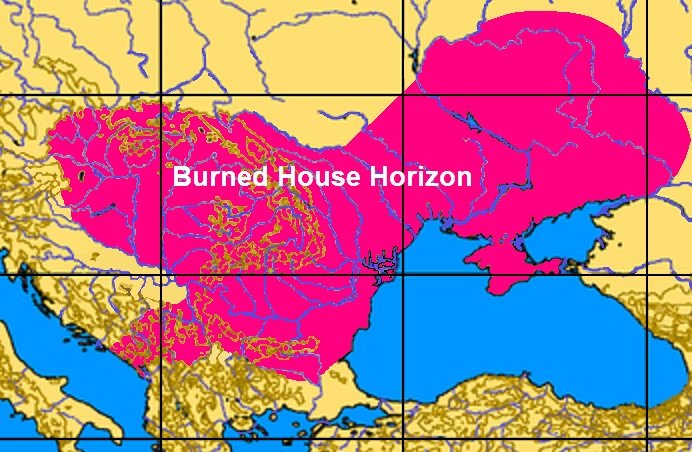
Imagine building a thriving village, living in it for decades, and then systematically burning every single building to the ground, only to rebuild directly on top of the ashes. Between 6500 BCE and 2000 BCE, this happened repeatedly across Southeastern and Eastern Europe.
Known by archaeologists as the “burned house horizon,” this phenomenon saw entire settlements destroyed in massive, synchronized infernos. For decades, experts debated whether these ancient blazes were the result of enemy raids or simple accidents. However, the physical evidence points to a deliberate practice of total destruction that involved massive community coordination, perhaps even to fight the deadliest diseases in history.
The Cucuteni-Trypillian Infernos
The Cucuteni-Trypillian culture built the largest settlements of their time. Yet, every 75 to 80 years, these massive communities went up in flames. When archaeologists dug into the ruins, they did not find typical fire damage. Instead, they uncovered thick layers of bright orange, vitrified clay.
The ancient homes were constructed using wattle-and-daub, a mixture of woven wood and wet earth. The fires that consumed them were so incredibly hot that they acted like a giant kiln, baking the raw clay walls into hardened ceramic rubble. Within the debris, researchers also found destroyed food stores, containers, and household items.
Failed Accidental Fire Experiments
Initially, researchers assumed the blazes were accidental, sparked by untended cooking hearths, or caused by invading armies. To test this, archaeologists built replica Neolithic houses and set them on fire. The results completely overturned the accident theory. An unchecked fire merely burned the thatched roofs and left the clay walls almost entirely intact, firing less than one percent of the material.
To achieve the intense, clay-baking heat found at the actual archaeological sites, the ancient inhabitants had to intentionally stack enormous quantities of extra fuel against the outside walls. Furthermore, scientists found no weapons or projectile points lodged in human skeletons to suggest warfare.
Plague Sterilization and Domicide
If the fires were not accidental, why would an entire community destroy its own food and shelter? Recent paleogenetics studies offer a biological clue. DNA of Yersinia pestis—the bacteria responsible for the plague—has been found in ancient mass burials from the era. Torching the entire village may have been a drastic but effective way to sterilize the area, killing off infected hosts and bacteria to halt an epidemic.
Another scientific consensus centers on “domicide,” the deliberate killing of a house. The inhabitants stacked huge amounts of fuel around the walls and torched the entire settlement to end the life of the structures. After the organized joint-community fire, the residents stayed in the exact same location, building brand-new houses directly on top of the old, burned foundations.