
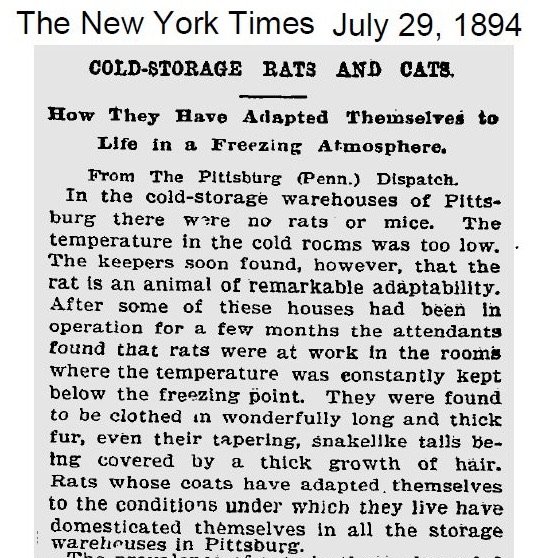
In 1894, a bizarre story swept across American newspapers about felines thriving in sub-zero temperatures. Dubbed the Pittsburgh Refrigerator Cat, this fictitious cat breed supposedly hunted arctic rats inside freezing warehouses.
Reports described thick-furred, chubby cats that would suffer fatal heat exhaustion if placed near a warm stove. The narrative grew so elaborate that it fooled the public and respected naturalists alike. The true events behind these widespread reports reveal a fascinating intersection of media exaggeration and basic biology.
The Rise of the Cold Storage Cats
Newspapers like the New York Times published accounts of cats adapting to extreme conditions inside Pittsburgh warehouses. Readers learned that rats from the freezing climate of Spitzbergen had infested the facilities. To combat this, the Pennsylvania Storage company supposedly introduced cats into the freezing vaults.
While most perished, one feline thrived. By 1895, the Pittsburgh Dispatch claimed these cold-loving cats slept on cooling pipes covered in a half-inch (13 mm) of frost in rooms maintained at 10 °F (-12 °C). Journalists insisted the freezing temperatures rejuvenated old cats into playful kittens.
Scientific Endorsement of the Eskimo Cat
The story caught the attention of British naturalist Richard Lydekker. Relying entirely on American newspaper clippings, Lydekker documented the cold storage cat in his 1896 Handbook to the Carnivora. He described them as a distinct breed possessing thick under-fur resembling a muskrat.
Because the warehouses were dimly lit, Lydekker claimed the cats grew extraordinary whiskers reaching 5 to 6 inches (130 to 150 mm) in length. He confidently asserted that any exposure to high temperatures would induce fatal seizures.
Debunking the Fictitious Cat Breed
Skepticism emerged quickly. In June 1895, Alice Bodington contacted the secretary of the Cold-Storage Company to verify the claims. The secretary confirmed the newspapers had heavily exaggerated the situation. Warehouse temperatures ranged from 10 to 40 °F (-12 to 4 °C), and the facility only had a mouse problem.
The company had temporarily relocated one ordinary warehouse cat to a cold room, where she gave birth to seven kittens. The temperature shift caused the cats to grow thicker winter coats, but their whiskers remained a completely normal length.
Uncovering the True Pittsburgh Felines
The story circulated for decades before American feline authority Ida M. Mellen investigated in 1949. Mellen interviewed locals who worked at the facilities in the 1890s and uncovered the biological truth. The original cats residing in the warehouse were not a new evolutionary breed.
A warehouse employee owned a female pink-eyed albino cat that gave birth in the cold room. The kittens were also pink-eyed albinos, highly sensitive to bright light, explaining their preference for dim warehouse interiors. The famous Pittsburgh Refrigerator Cat was simply a family of albino cats developing thicker coats to survive the chill.