
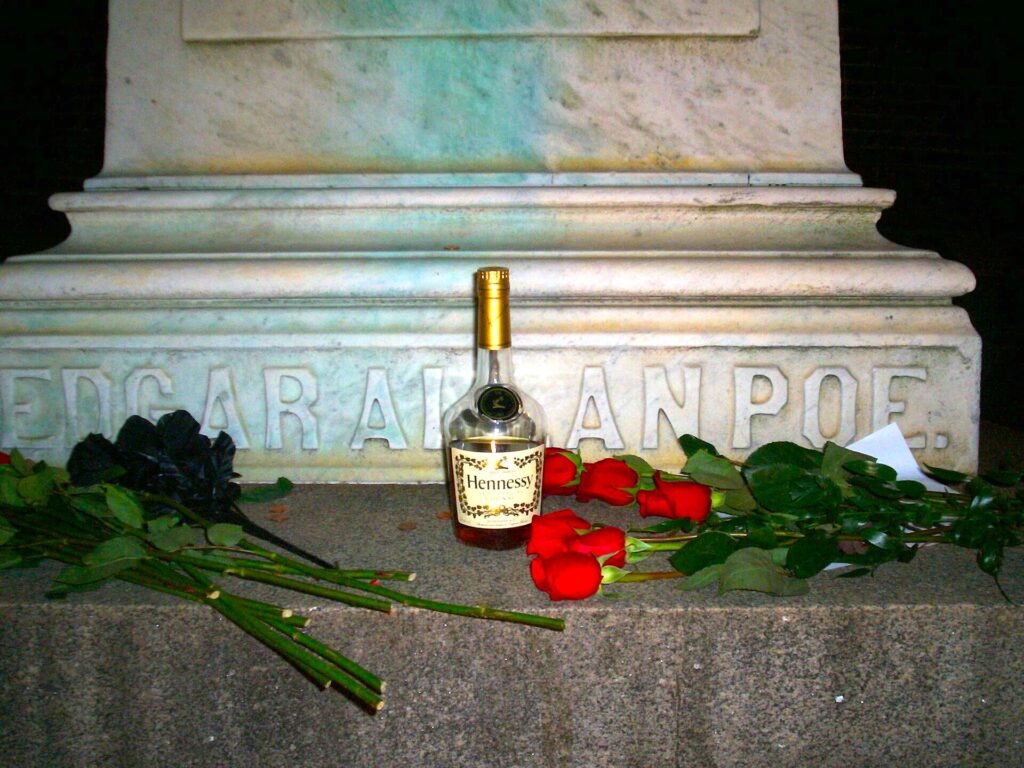
For over seven decades, an anonymous figure performed a solitary, secretive tribute at the grave of Edgar Allan Poe. Arriving under the cover of darkness on the anniversary of the author’s birth, the unidentified visitor poured a glass of cognac, arranged three red roses, and vanished before dawn.
The true identity of the man—and the son who eventually inherited the role—was never conclusively proven, cementing the “Poe Toaster” as one of the most enduring literary mysteries in modern American history.
The Ritual of Roses and Cognac
The original gravesite of Edgar Allan Poe lies in the Westminster Hall and Burying Ground in Baltimore, Maryland. Beginning at least as early as the 1930s, a man dressed entirely in black, wearing a wide-brimmed hat and a white scarf to obscure his face, arrived at the cemetery in the early hours of January 19. Using a silver-tipped cane, the man approached the grave and executed a precise ritual.
He poured a glass of Martell cognac, raised a toast to the deceased author, and arranged three red roses in a highly specific configuration. The flowers likely represented Poe, his wife Virginia, and his mother-in-law Maria Clemm, all originally interred at the site. The Toaster never sought publicity and always left the unfinished bottle of cognac behind as he disappeared into the night.
Passing the Torch to a Son
The solitary ritual continued undisturbed for decades. The Toaster occasionally left short notes alongside the bottle, usually simple messages of devotion like, “Edgar, I haven’t forgotten you.” In 1993, the figure left a cryptic message reading, “The torch will be passed.” In 1999, a new note confirmed that the original Toaster had passed away in 1998, leaving the responsibility to “a son.”
Observers waiting outside the cemetery in subsequent years confirmed that the post-1998 Toaster appeared physically younger. However, the son seemed less devoted to the solemnity of the tradition. Notes left in 2001 and 2004 referenced current events, including a Baltimore Ravens football game and French opposition to the Iraq War.
The False Claims of Sam Porpora
As the mystery grew, some attempted to claim credit for the phenomenon. In 2007, a 92-year-old former historian for the Westminster Church named Sam Porpora claimed he invented the Poe Toaster in the 1960s as a publicity stunt to bring attention to the congregation.
Porpora claimed he lied to reporters about the visits starting earlier. However, historical evidence easily disproved his timeline; an article in the Baltimore Evening Sun explicitly detailed the ritual of the anonymous citizen leaving an empty bottle against the gravestone in 1950. Porpora later retracted his claim, admitting someone else was performing the ritual.
The End of a 75-Year Tradition
In 2009, the Toaster performed the ritual for the bicentennial of Poe’s birth but left no note. The following year, in 2010, the Poe Toaster never arrived. Over the next two years, several impostors attempted to mimic the ritual in full view of observers, but none knew the Toaster’s secret signal or the specific arrangement of the roses.
By 2012, Jeff Jerome, the former curator of the Poe House and Museum who had witnessed the event since 1976, officially declared the 75-year tradition over. While the Maryland Historical Society selected a public successor in 2016 to continue the tribute in daylight, the true identity of the original Poe Toaster remains entirely unknown.