
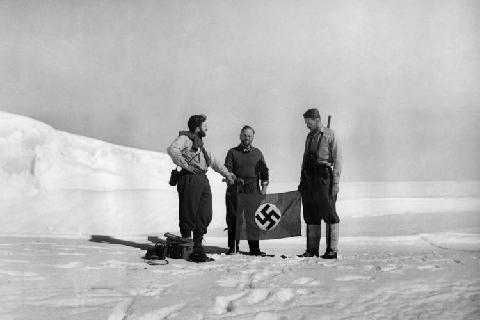
In the final months of 1938, a German freighter loaded with catapult-launched seaplanes quietly slipped out of Hamburg. Its destination was the frozen edge of Antarctica. The crew of the MS Schwabenland carried secret military orders and an ambitious economic mission that would push them into uncharted ice valleys.
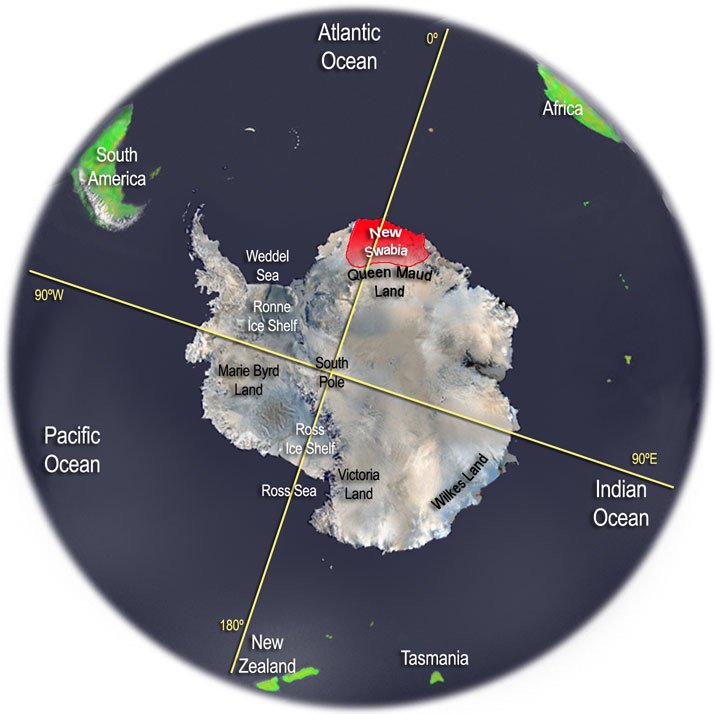
They sought to map an unknown continent from the sky, drop thousands of metal darts over the freezing terrain, and secure an essential raw material. This voyage birthed the cartographic region of New Swabia, a land of massive glaciers and hidden summer lakes.
The Hunt for Whale Oil and Strategic Ground
The primary motivation for the 1938-1939 German Antarctic Expedition was highly practical. Germany was importing 200,000 metric tonnes (220,462 tons) of Norwegian whale oil annually to produce margarine and soap. Facing a potential war, the country needed its own whaling station to protect its foreign currency reserves.
Captain Alfred Ritscher led 82 crew members aboard the MS Schwabenland, a ship modified to launch aircraft. The expedition also carried a hidden military directive to evaluate remote islands for naval bases.
Seaplanes and Swastika Darts over the Ice
Reaching the Princess Martha Coast on January 19, 1939, the team faced an area recently claimed by Norway as Queen Maud Land. The Germans named their surveyed territory Neu-Schwabenland. Two Dornier Wal seaplanes launched from the ship, executing seven massive photographic flights.
They captured over 16,000 aerial photographs across hundreds of thousands of square kilometers (tens of thousands of square miles). At the turning points of their flight paths, the crew dropped 1.2-meter (3.9-foot) aluminum darts equipped with 30-centimeter (11.8-inch) steel cones.
High Peaks and Ice-Free Oases
The mapped geography proved extreme. A coastal ice shelf rises to a 1,000-meter (3,281-foot) foreland, giving way to inland mountain ranges exceeding 3,000 meters (9,843 feet). These peaks trap enormous glaciers at elevations of 2,000 meters (6,562 feet). The expedition also discovered the Schirmacher Oasis. This 34-square-kilometer (13.1-square-mile) plateau features 118 freshwater lakes that become ice-free during the summer.
Summer temperatures on exposed rock surfaces can reach +19°C (66.2°F), allowing simple lichens, mosses, and algae to grow. In the Gruber Mountains, the much larger Obersee and Untersee lakes remain completely covered in thick ice year-round. Obersee covers 3.43 square kilometers (1.3 square miles), while Untersee spans 11.4 square kilometers (4.4 square miles).
A Quiet Return and Modern Realities
The MS Schwabenland returned to Germany in April 1939. Norway had already learned of the covert mapping flights through a chance conversation involving a geologist’s wife. Ultimately, Germany never established a whaling station or made formal territorial claims to the region. The area remains under the administration of the Antarctic Treaty System as part of Queen Maud Land.