
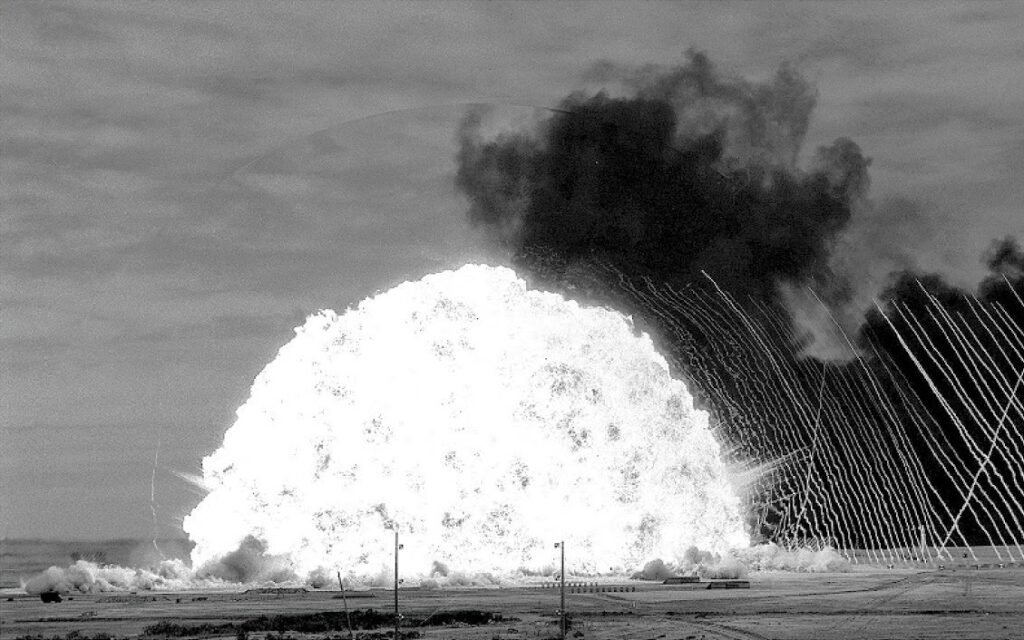
In 1964, military researchers stacked 500 short tons (450 metric tons) of TNT on the Alberta prairie and detonated it to study nuclear blast effects using conventional explosives. Known as Operation Snowball, it was the largest man-made, non-accidental explosion in Canada. Preparing the single blast took two years of casting explosive blocks, a wheeled building over ground zero, and military rockets and armored vehicles positioned across the plain. When it blew, the charge sent up a mushroom cloud and carved a moon-like crater that sparked speculation among scientists.
Casting 30,678 Blocks of TNT on the Alberta Prairie
Canada’s Defence Research Board ran Operation Snowball with the United Kingdom and the United States under the Tripartite Technical Cooperation Program. They selected the Suffield Experimental Station in Alberta, part of a 1,000-square-mile (2,600-square-kilometer) treeless prairie range offering clear visibility and favorable weather.
On-site casting started two years ahead of the blast. Workers poured molten TNT into 12-by-12-by-4-inch (300-by-300-by-100-millimeter) rectangular molds and let them cool for five hours, producing 30,678 smooth, caramel-colored blocks averaging 32.6 pounds (14.8 kilograms) each. Joint teams assembled starting in fall 1963, and an unusually mild winter helped crews build specialized test gear in the station’s workshops.
Building a Giant Explosive Hemisphere Under Cover
Stacking began six days before detonation. To shield the TNT from sunlight, dust, and lightning, workers erected a temporary building over ground zero and fitted each block into a pre-calculated position. Once the stack formed a near-perfect hemisphere measuring 34 feet (10 meters) in diameter, crews wheeled the building away. It was the first stacked TNT hemisphere built at that scale.
Rockets, Buried Targets, and Soil Columns
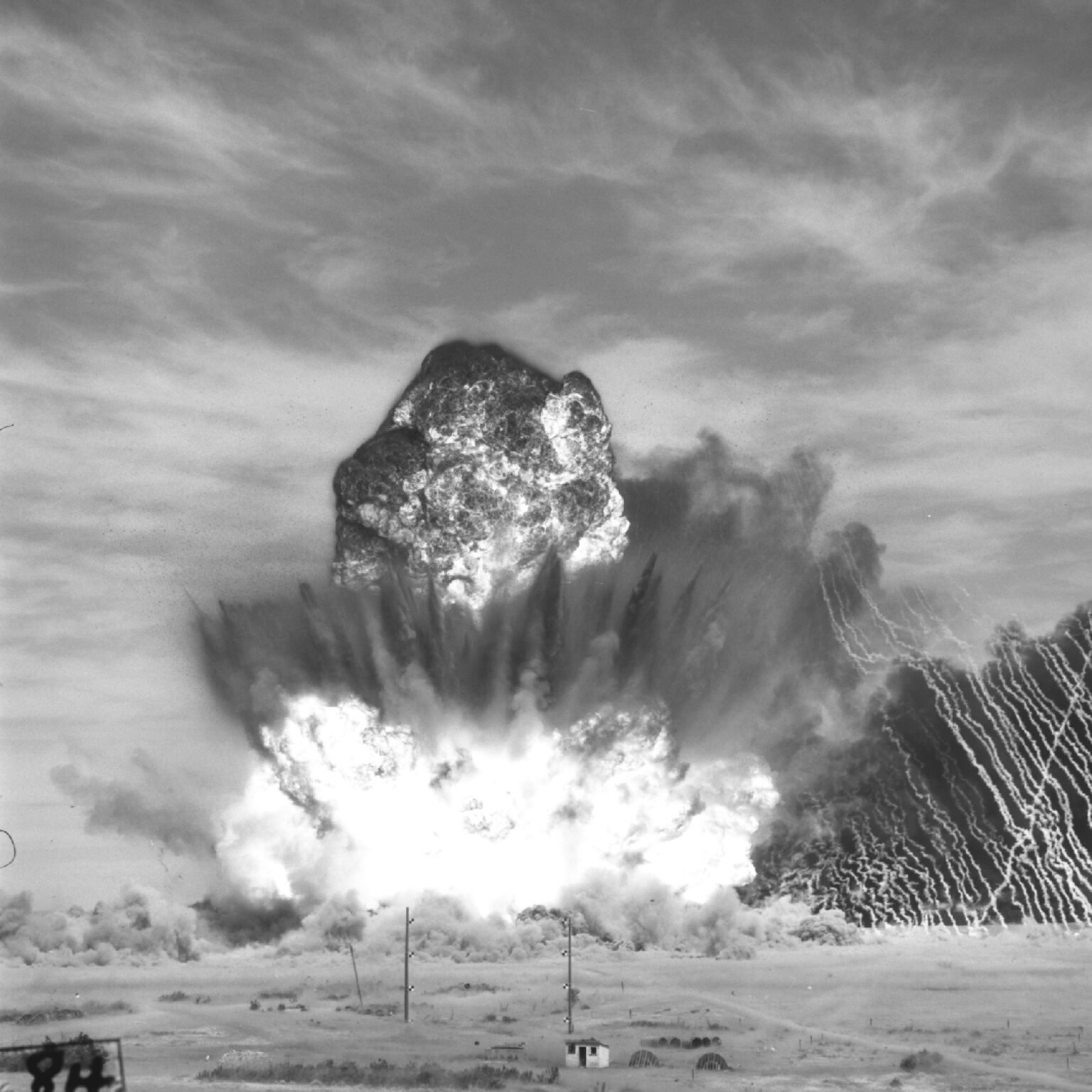
Engineers drilled columns 80 feet (24 meters) into the earth and backfilled them with colored soil to track horizontal and vertical ground displacement. Military targets surrounded the site, including heavy Jupiter and Nike configuration rockets delivered by rail flatcar, a minefield, chambers, tunnels, reinforced concrete arches, fiberglass shelters, gas masks, armored vehicles, and full-scale troop models. Sixty percent of the targets were buried. Smoke mortars stood ready to fire white trails to track the shock wave aloft while an RCAF Neptune aircraft flew directly above the blast zone for aerial photography.
Fireball, Flipped Vehicles, and a Moon-Like Crater
The explosion converted the TNT into highly pressurized gas, sending up a large fireball and a mushroom-shaped cloud. Overpressure moved and damaged the heavy rockets and flipped two M113 armored personnel carriers onto their sides. The blast carved a crater 240 feet (73 meters) across that partially filled with water within minutes and showed an unexpected central formation similar to moon craters. Teams later excavated a full cross section of the crater to study underground effects, and six subsequent tests, including Operation Sailor Hat and Prairie Flat, repeated the stacked-hemisphere design.