
Buried beneath the volcanic ash of Mount Vesuvius in 79 AD, the library of Herculaneum was completely carbonized. For nearly two millennia, the remaining papyrus scrolls presented an impossible problem. The intense heat had turned them into fragile, blackened lumps of carbon.
Attempting to physically unroll the documents caused them to crumble into dust. The texts remained completely inaccessible to researchers. Now, using advanced technology, scientists have successfully read a complete scroll known as PHerc. 1667 without ever physically opening it.
Digital Unwrapping Using X-Rays and AI
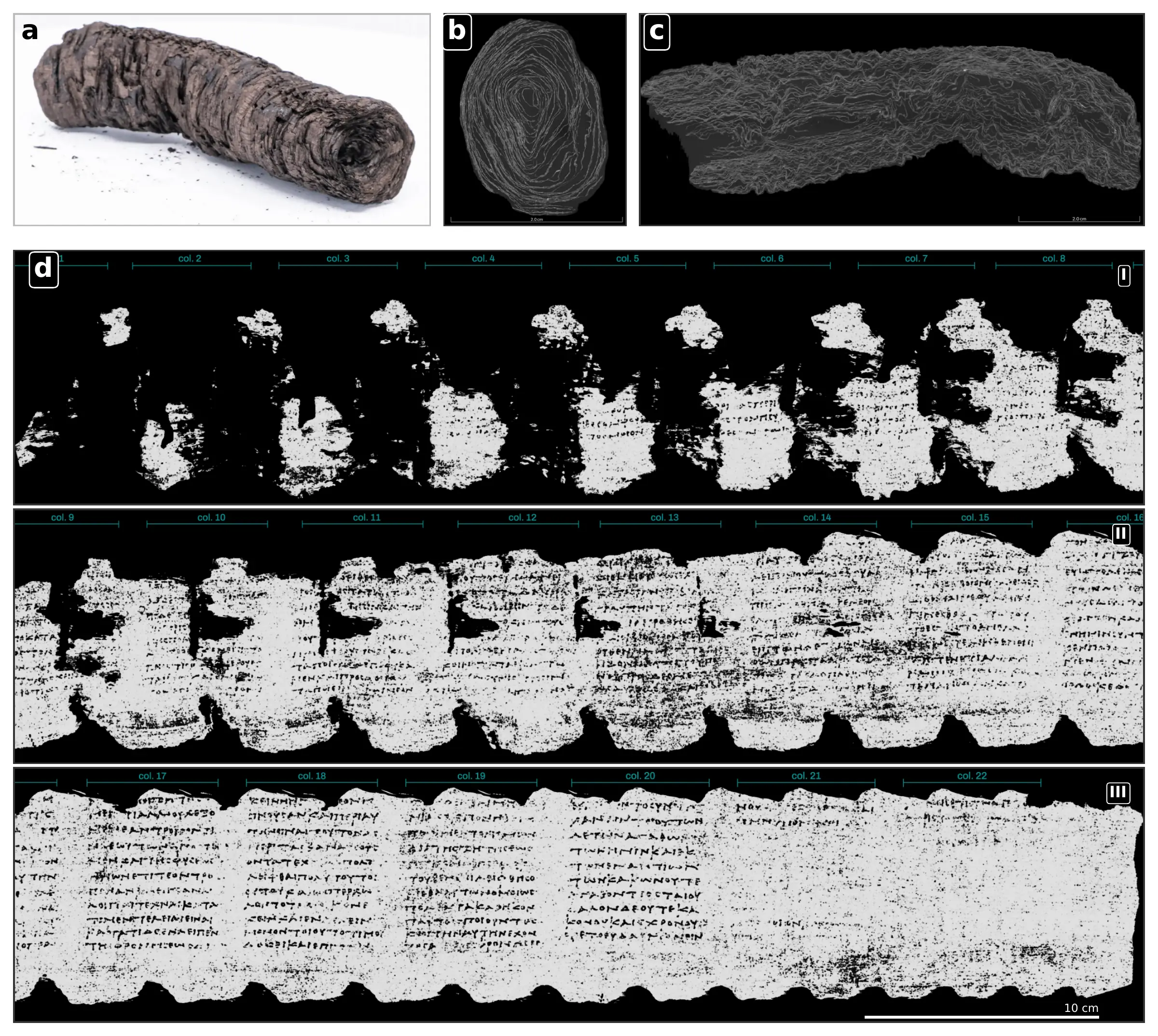
Researchers utilized phase-contrast X-ray microtomography at the European Synchrotron Radiation Facility in Grenoble to scan the internal structure of the sealed papyrus. After mapping the internal geometry of the wound sheet, the team flattened the surface digitally.
They then deployed machine learning algorithms to detect the ancient ink, which is nearly identical in composition to the burned papyrus. This process produced a continuous, unrolled surface measuring 1.4 meters (4.6 feet) long, containing roughly twenty-two columns of ancient Greek text.
Decoding a Lost Stoic Text
Previous attempts to physically open PHerc. 1667 in the nineteenth and twentieth centuries destroyed its outer layers. The remaining core measures just 8 cm (3.1 inches) high, a fraction of its original 19 to 24 cm (7.5 to 9.4 inches) height. From this compact section, papyrologists transcribed the recovered writing.
The text is a philosophical treatise focusing on ethics, human nature, and impulse. The final column names Aristocreon, a disciple and nephew of the Stoic philosopher Chrysippus. These specific details allow experts to date the document to the second century BC and classify it as a Stoic work.
High-Resolution Ink Detection
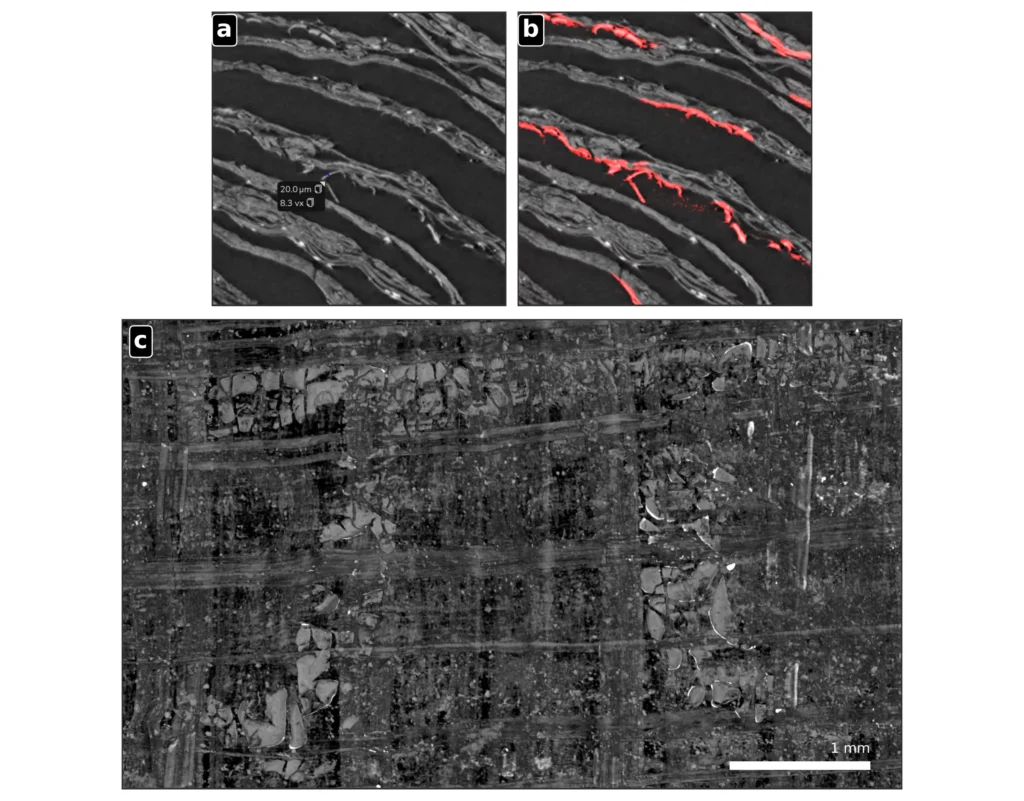
The breakthrough extends beyond a single document. In another scroll labeled PHerc. Paris 4, researchers applied higher-resolution imaging to make the ink directly visible within the three-dimensional scan data. The ink was segmented in 3D and projected onto the digitally unwrapped page. This new data precisely matches the text recovered during the 2023 Vesuvius Challenge.
Additionally, the team successfully read the title of a third document, PHerc. 139. The enhanced scan revealed the author and work as Philodemus, On Gods, Book 8, allowing researchers to identify the contents without unrolling the main body of the text.
Open Access to Ancient Data
The techniques used to read these carbonized documents have been made completely public. The tomographic scans, reconstructed digital surfaces, and full transcriptions are available online under a Creative Commons license. The software code used for the machine learning and mapping processes is also accessible for anyone to review or utilize.
Hundreds of unread Herculaneum scrolls remain sealed. Scientists and programmers from around the world can now use this exact methodology to scan, digitally unroll, and read the rest of the carbonized library.