
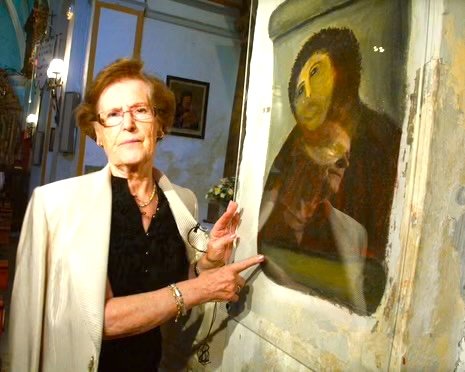
When an 81-year-old amateur artist tried to fix a flaking Spanish church painting, the result looked more like a hairy primate than Jesus Christ. In 2012, Cecilia Giménez applied her paintbrush to the Ecce Homo fresco in Borja, Spain, intending to repair moisture damage.
Instead, her unfinished work became a viral global joke dubbed “Monkey Christ” that initially brought her intense humiliation. Yet this exact botched restoration sparked a massive tourism boom that generated thousands of euros and transformed the local economy.
A Well-Intentioned Artistic Attempt
Spanish painter Elías García Martínez originally painted the Ecce Homo fresco directly onto the walls of the Sanctuary of Mercy church around 1930. Over the decades, excessive moisture caused the artwork to deteriorate and flake away. In 2012, an 81-year-old parishioner named Cecilia Giménez decided to intervene.
Working in broad daylight with the knowledge of the local clergyman, she began painting over the damaged sections. She left the paint to dry and departed for a two-week holiday, fully intending to finish the job upon her return.
The Birth of the Monkey Christ
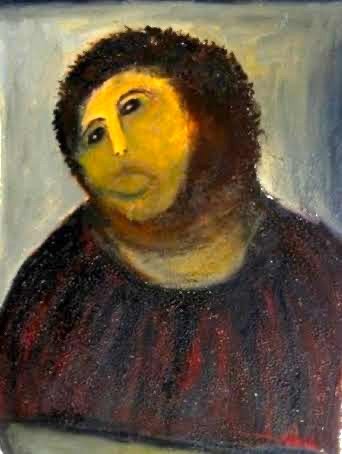
When she returned, photographs of her incomplete work had already circulated worldwide. The altered fresco barely resembled the original portrait of Jesus crowned with thorns. A BBC Europe correspondent described the new face as a crayon sketch of a very hairy monkey wearing an ill-fitting tunic.
The internet quickly renamed the artwork Ecce Mono, which translates roughly to “Behold the Monkey.” Initially, Borja authorities suspected vandalism, and the priest considered covering the altered mural completely.
Global Backlash and Media Attention
The immediate notoriety caused severe distress for Giménez. She experienced severe panic, refused to eat, and dropped six kilograms in weight. Meanwhile, descendants of the original painter threatened to pursue legal action.
Despite the controversy, the altered fresco gained massive traction on mainstream and social media. The incident later inspired a comic opera in Las Vegas and television documentaries like Fresco Fiasco.
Accidental Tourism and Charity Revenue
The massive media attention drove thousands of people to Borja. The town went from hosting 6,000 annual visitors to 57,000 at its peak. The church instituted a €3 entry fee to view the painting, generating over €40,000 annually. This money funded church maintenance, paid staff salaries, and supported low-income residents at a local care facility.
In 2013, Giménez secured an agreement to receive 49 percent of all merchandising profits, which she directed to a muscular dystrophy charity to help her son. She died in December 2025 at the age of 94, having watched her unfinished painting put her village on the map.