A wooden pyramid dropping from the sky, a mechanical knight walking on its own, and an armored vehicle carrying 36 guns. These concepts sound like modern engineering projects. They actually originated in the 15th century during the 67-year life of Leonardo Da Vinci.
While he worked as an artist and scientist, his mechanical designs pushed the boundaries of what was physically possible at the time. From underwater warfare gear to early aviation concepts, Da Vinci drafted blueprints for devices that would not physically exist for hundreds of years. The following sections detail five specific machines he designed, revealing exactly how his prototypes operated and why some contained deliberate engineering flaws.
The Early Parachute And Human Flight
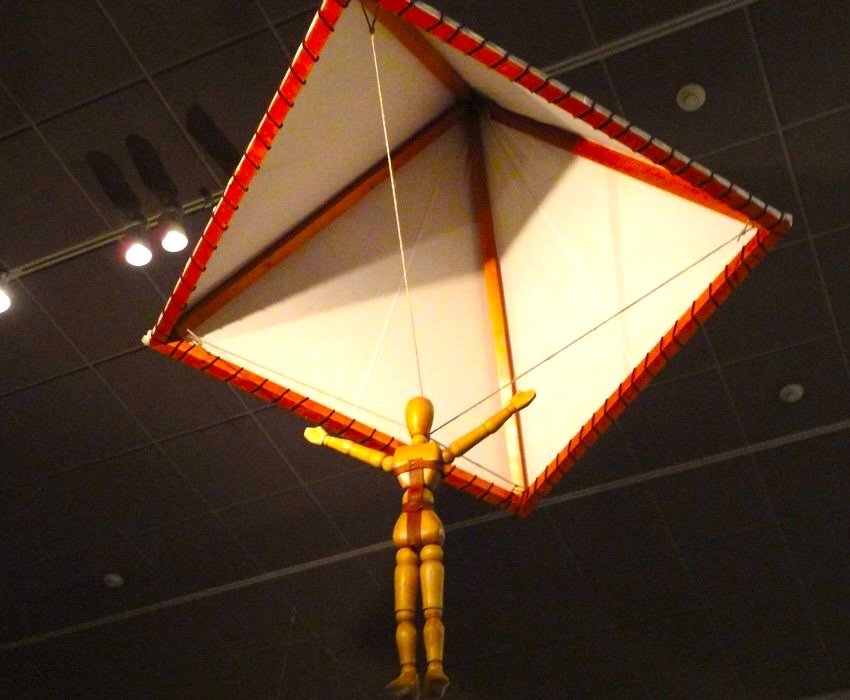
Da Vinci wanted to find a way for people to drop from high altitudes without injury. He designed a parachute using a wooden pyramid frame covered in cloth. This structure was calculated to slow down terminal velocity as a person fell to earth. He also observed bats and birds to draft the Ornithopter, an early flying machine.
A pilot would lie in the center and pedal a crank attached to a rod-and-pulley system to flap the wings. The tools required to construct a functioning version were unavailable during his life, keeping the machine firmly grounded.
Underwater Sabotage And The Diving Suit
Military leaders frequently hired Da Vinci to develop defense technology. He created a diving suit specifically for soldiers to sneak underwater and cut holes into the hulls of invading ships. This suit featured a breathing hose and glass goggles. The military did not ultimately require the suits at the time, keeping the project entirely in the conceptual planning phase.
The Armored Tank And The 33-Barreled Organ
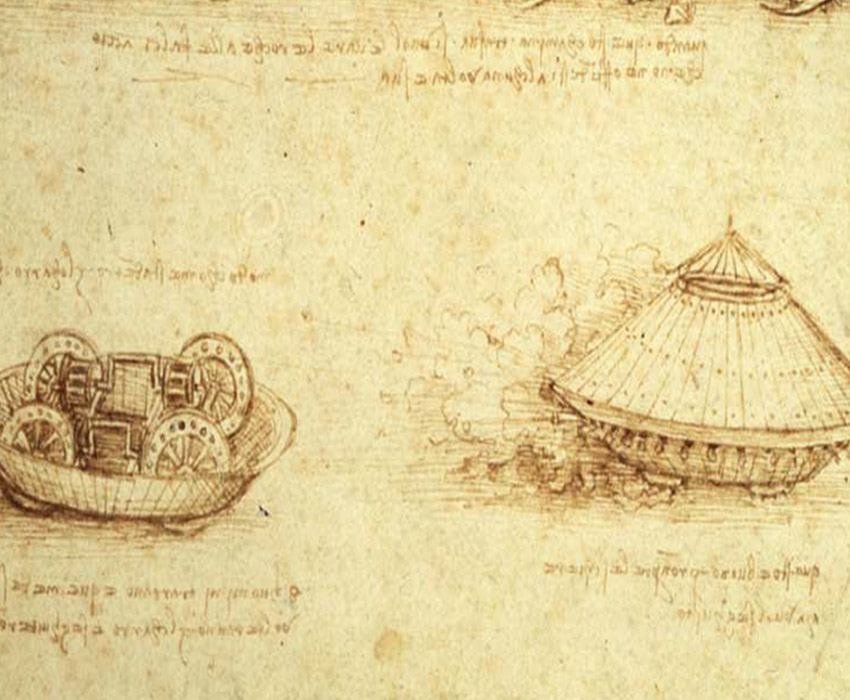
While working for the Duke of Milan, Da Vinci drafted an armored war machine. This tank required eight men to drive it and housed 36 guns. The surviving diagrams show a critical gear error where the front and rear wheels rotate in opposite directions. Historians evaluate this as a deliberate strategic choice to prevent enemies from stealing and building a working model.
He also designed a weapon called the 33-barreled organ. It grouped 11 muskets that fired sequentially and rotated so the barrels could cool off between volleys. Da Vinci created these weapons to generate income for his household.
The 15th-Century Robotic Knight
For a pageant in Milan, Da Vinci drafted the first humanoid robot. Utilizing gears, wheels, and cables, the robotic knight could sit, move its head, and independently lift its visor. In 2002, a Minnesota engineer named Mark Rosheim spent five years studying these specific manuscripts. He successfully built a physical version of the robot that could walk and wave. Rosheim then utilized this 15th-century mechanical foundation to develop robotic designs for NASA.