
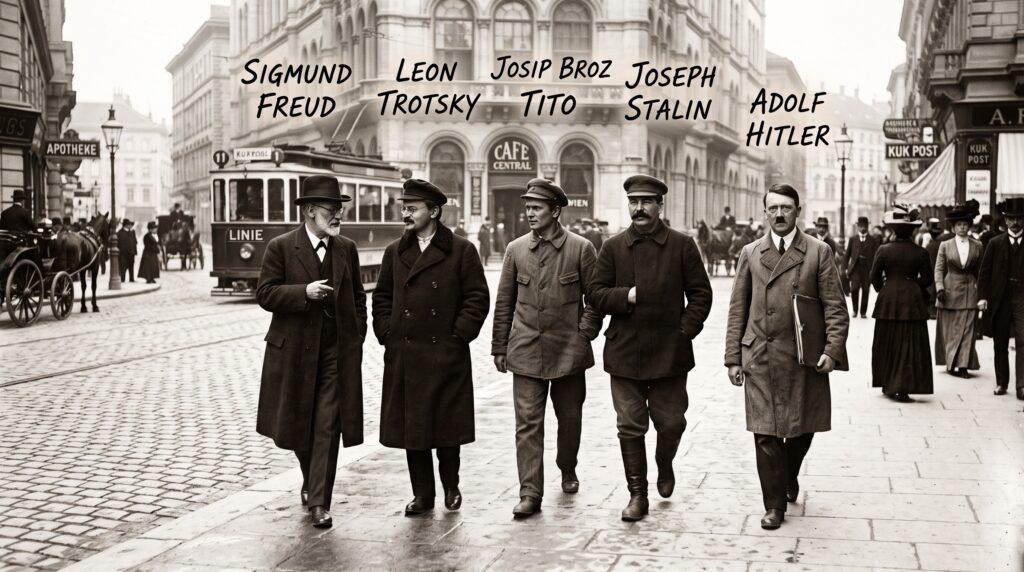
Before they led nations or authored revolutionary theories, five prominent men quietly navigated the exact same streets of a bustling European capital in 1913. Adolf Hitler, Joseph Stalin, Leon Trotsky, Sigmund Freud, and Josip Broz Tito all resided within a short distance of each other. They inhabited a city teeming with both extreme wealth and bleak poverty, sharing the exact same two-square-mile (5.2-square-kilometer) radius of central Vienna.
A City of Empires and Languages
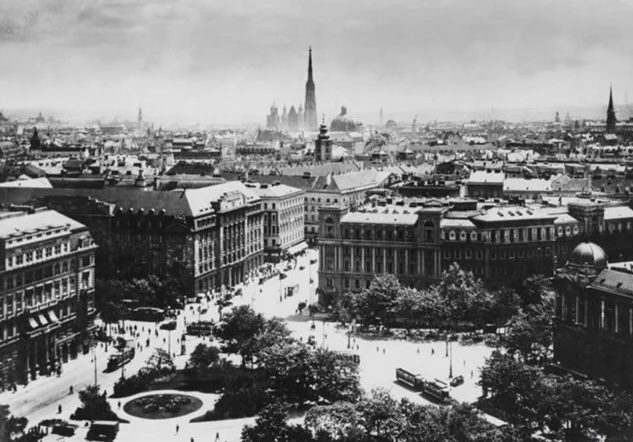
Vienna served as the capital of the Austro-Hungarian Empire, a sprawling territory encompassing 15 nations and over 50 million inhabitants. The city itself held two million residents, with less than half being native-born. Immigrants from Bohemia and Moravia filled the streets, making Czech a common language alongside German. The empire required Austro-Hungarian Army officers to issue commands in 11 different languages. Emperor Franz Joseph ruled from the Hofburg Palace, while his successor, Archduke Franz Ferdinand, lived at the nearby Belvedere Palace.
Fugitives and Factory Workers
In January 1913, a man carrying a basic wooden suitcase arrived at the North Terminal station using a passport bearing the name Stavros Papadopoulos. This man, Iosif Vissarionovich Dzhugashvili, known to friends as Koba and later as Joseph Stalin, went to meet Leon Trotsky. Trotsky later wrote that Stalin was short, thin, and had grayish-brown skin covered in pockmarks. Both men were Russian dissidents currently on the run. To the south, in Wiener Neustadt, a young Josip Broz Tito worked at a Daimler automobile factory. Meanwhile, a 24-year-old Adolf Hitler lived in a Meldermannstrasse doss-house near the Danube after the Vienna Academy of Fine Arts rejected his painting applications twice.
The Coffee House Crossroads
The intellectuals and outcasts of Vienna gathered frequently in local cafes. Sigmund Freud, an established psychoanalyst, practiced on Berggasse and frequented Cafe Landtmann. Trotsky and Hitler spent their time at Cafe Central. These locations hosted intense discussions among a diverse population, fueled by the energy of the Jewish intelligentsia who received full citizenship rights in 1867. Women also held prominent roles in this society, such as Alma Mahler, a composer who interacted closely with local artists and architects.
The Eve of Global Collapse
Despite the cultural exchange, the city had a distinctly dark reality. Massive slums housed thousands of impoverished citizens, and nearly 1,500 Viennese residents took their own lives in 1913 alone. No historical records confirm whether Hitler ever crossed paths with Trotsky or if Tito spoke to Stalin within these city boundaries. The following year, the assassination of Franz Ferdinand ignited World War I. By 1918, the Austro-Hungarian Empire completely collapsed, and the men who had shared this brief proximity dispersed to pursue their respective political and professional paths.