
When picturing the largest living organisms on Earth, most people visualize enormous animals like blue whales or elephants. However, a sprawling, subterranean species of fungi actually holds the record.
Known widely as the “humongous fungus,” these organisms grow to jaw-dropping sizes and can live for thousands of years beneath the soil. The story of how scientists accidentally discovered these colossal honey mushrooms reveals an invisible world stretching across vast distances right beneath our feet.
A Chance Discovery in Michigan
The first heavily documented humongous fungus was found by chance in Crystal Falls, Michigan, during the 1980s. Researchers from the Department of Defense were studying the environmental impacts of Extremely Low Frequency (ELF) radio waves on local trees and plants. During this study, scientists noticed an Armillaria gallica fungus consuming the local trees.
In a 1992 study, they initially estimated that this single organism covered 37 acres (15 hectares), weighed 110 tons (99.8 metric tons), and was around 1,500 years old. This specific discovery prompted journalists to coin the phrase “humongous fungus,” a nickname that quickly stuck.
The True Scale of Armillaria gallica
In 2018, scientists returned to Crystal Falls to conduct a new DNA analysis of 245 fungal samples. They discovered that the Michigan fungus was actually much older and larger than original estimates.
The single organism is about 2,500 years old and spans roughly 90 to 91 acres (36.4 to 36.8 hectares). It weighs approximately 440 tons (399.2 metric tons), which is equivalent to the mass of three blue whales. Today, Crystal Falls celebrates this massive organism every August with a “Humongous Fungus Festival” featuring a parade and a t-shirt design contest.
Unearthing the Oregon Behemoth
While the Michigan mushroom is vast, the title for the largest single living organism by biomass belongs to an Armillaria ostoyae located in Oregon’s Malheur National Forest.

A Forest Service employee named Greg Whipple first investigated a fungal infestation there in 1988. Genetic research ultimately proved that a single organism covers 2,385 acres (965 hectares), or about 3.7 square miles (9.6 square kilometers). Scientists estimate this Oregon behemoth weighs up to 35,000 tons (31,751 metric tons) and could be 8,650 years old.
How the Honey Mushroom Spreads
These massive organisms survive through a network of subterranean black tendrils called rhizomorphs. Researchers in Hungary determined that these filaments likely evolved from genes responsible for growing mushroom stems.
- Rhizomorphs spread slowly beneath the soil at a rate of 0.7 to 3.3 feet (0.2 to 1 meter) per year.
- They parasitize tree root systems and create fungal mats under the bark, a process that can take twenty to fifty years to kill a tree.
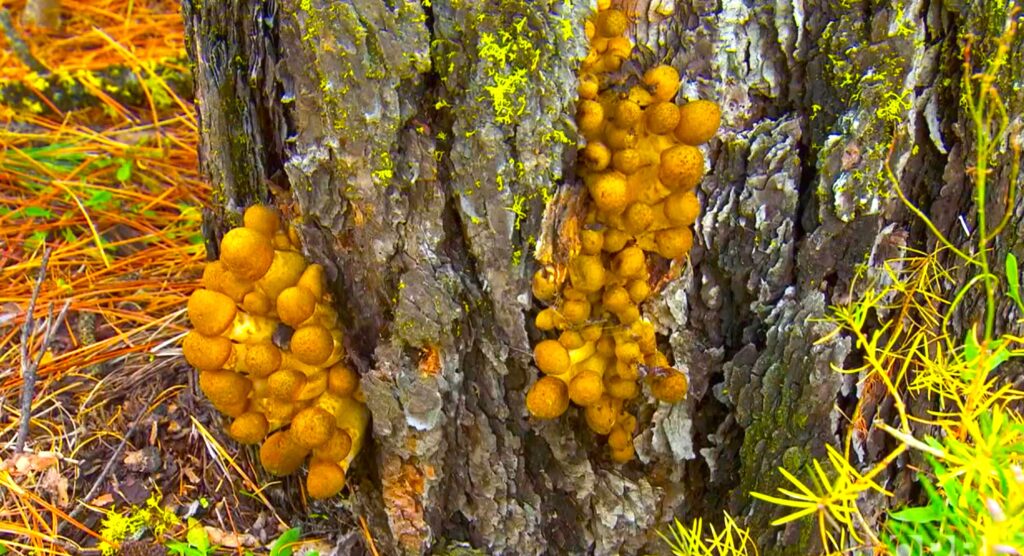
- In the fall, the fungus fruits above ground as gilled, brown honey mushrooms.
These edible mushrooms can cause stomach distress, meaning they must be thoroughly cooked before eating.