
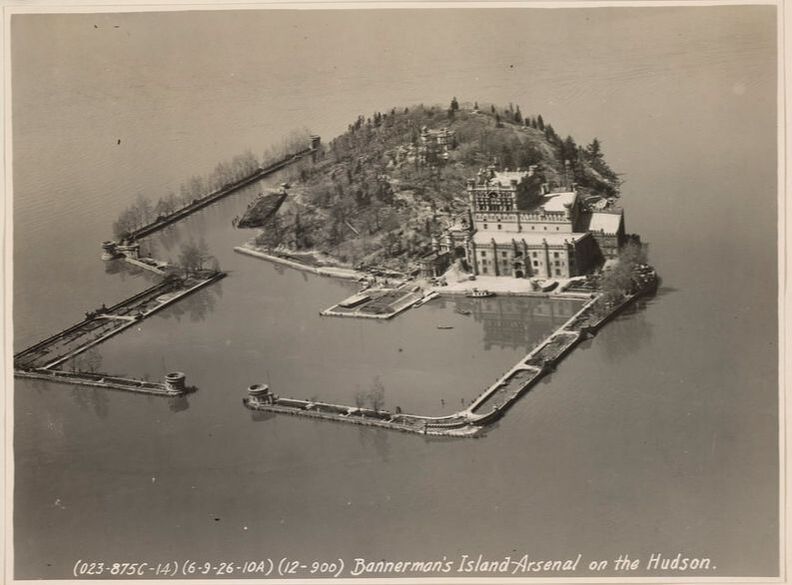
Sixty miles north of New York City, a ruined Scottish-style fortress sits on an isolated island in the Hudson River. This structure was not built by medieval royalty, but by a twentieth-century Brooklyn weapons dealer forced out of Manhattan.
Abandoned after a massive explosion and a devastating fire, the island is heavily layered with local folklore involving goblin kings and ghost ships. The true sequence of events regarding this architectural oddity involves two hundred tons of detonated black powder, napkin sketches, and an eventual modern revival.
An Eccentric Tycoon’s Napkin Designs
Francis Bannerman was a pacifist arms dealer with a massive inventory of military surplus and highly flammable black powder. When New York City mandated he relocate his volatile stockpile, his son spotted Pollepel Island while canoeing. Bannerman purchased the island in 1900. Without hiring professional architects, he drafted blueprints on the backs of envelopes and napkins.
The resulting complex featured Moorish, Belgian, and Scottish design elements, entirely devoid of right angles. Cannons and artillery were ferried up the river to the arsenal, which prominently displayed “Bannerman’s Island Arsenal” on its stone facade. He and his wife Helen also constructed a summer residence, complete with imported soil, a moat, and an outhouse built for two.
The Heer of Dunderberg Folklore
Before the arsenal’s construction, Pollepel Island was notorious among seventeenth and eighteenth-century Dutch sailors. Heavy winds and violent storms frequently battered the surrounding waters. Seafarers attributed these weather events to the “Heer of Dunderberg,” a goblin king believed to command an army of imps and summon squalls.

During these storms, sailors claimed to hear the phantom captain of The Flying Dutchman shouting orders. This mythology was documented, and potentially invented, by author Washington Irving in his 1822 short story “The Storm-Ship.”
Explosions and a Suspected Arson
Bannerman died in 1918, leaving the complex unfinished. In 1920, the arsenal’s powder house detonated. The blast ignited two hundred tons of shells and black powder, shattering windows and blowing a section of the tower directly into the Hudson River.
The explosion was loud enough to be heard from Poughkeepsie to Peekskill. The Bannerman family escaped the blast and lived there until 1930. New York State purchased the deteriorating property in 1967. Two years later, a suspected arsonist set a fire that burned the remaining structures into ruins.
The Modern Revival of the Ruins
The state initially banned access to the hazardous, snake-infested island. In 1992, Neil Caplan established the Bannerman Castle Trust to stabilize the crumbling masonry and clear the overgrown paths. Today, the trust operates boat tours from April through October.
The stabilized grounds currently host outdoor theater performances, horror movie screenings, and farm-to-table dining events, recently including a recreation of an eleven-course dinner from the Titanic.