
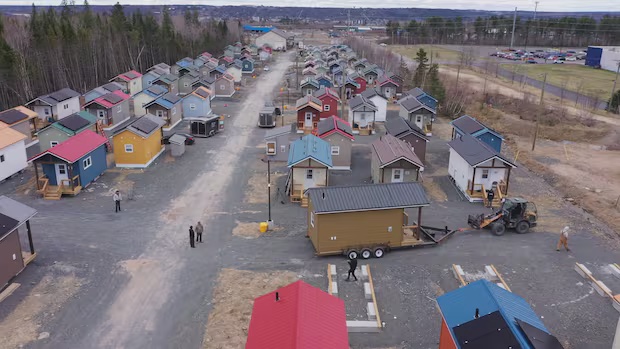
In 2021, a multi-millionaire software engineer named Marcel LeBrun made a significant career change. After selling his successful social media monitoring company, Radian6, he did not retire or start another tech firm. Instead, he purchased a 65-acre (26-hectare) plot of land in Fredericton, New Brunswick, and committed 4.5 million dollars of his personal wealth to tackle the local housing shortage.
His goal was to construct a new neighborhood from scratch specifically for the city’s unhoused population. The resulting project, known as 12 Neighbours, transformed an empty lot into a village with permanent housing and active businesses for people previously living on the streets.
The Blueprint for 12 Neighbours
The 12 Neighbours community consists of 99 individual tiny homes, arranged in small neighborhood blocks. Each home provides 240 square feet (22.3 square meters) of living space. These structures are not temporary shelters. Every house is equipped with a full kitchen, a three-piece bathroom, living space with cathedral ceilings, and loft storage.
The houses are fully insulated and connected to the city’s power grid, municipal water, and sewage systems. Tenants pay no more than 30 percent of their income in rent, ensuring the housing remains permanently affordable.
An Assembly Line for Houses
To achieve this massive construction goal efficiently, LeBrun approached the project like an engineer. He secured a donated 8,000-square-foot (743-square-meter) warehouse for indoor manufacturing. Inside this facility, a team of 19 paid carpenters and plumbers constructs the homes on an assembly line.
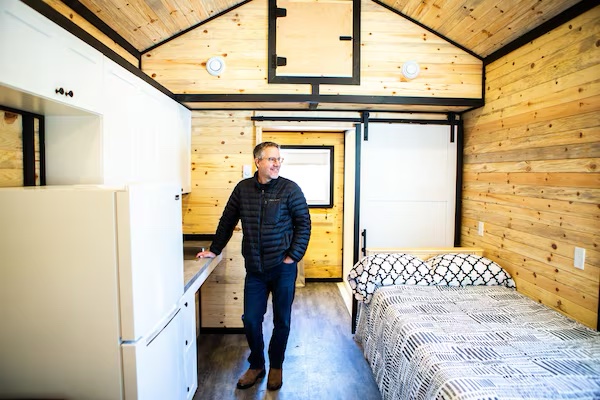
The homes are built using pine wood and metal directly on top of trailers. Once finished, they are towed intact to the site. Operating at full capacity, this dedicated team produces a brand new, fully completed tiny home every four business days.
A Fully Integrated Social Enterprise
Providing shelter was only the first step of the project. The 12 Neighbours site includes a dedicated Social Enterprise Centre. This facility features a coffee shop, a retail store, and a print lab. These businesses are operated by the residents themselves, providing them with paid employment, new skills, and daily routines.
For example, resident Al Smith moved from living in a pop-up camper to working as the head of production and quality control in the print lab. Other residents produce and sell art, or work in the community gardens and on the construction team.
Navigating Real-World Challenges
Operating a concentrated housing community brings logistical challenges. The organization has had to implement security gates at the entrances that close overnight to prevent squatting and ensure resident safety.
LeBrun received 13 million dollars in funding from the provincial and federal governments to cover the remaining costs of the 12 million dollar initial estimate. By combining private wealth, government funding, and industrial efficiency, 12 Neighbours stands as a fully operational neighborhood that actively houses over 100 people today.