
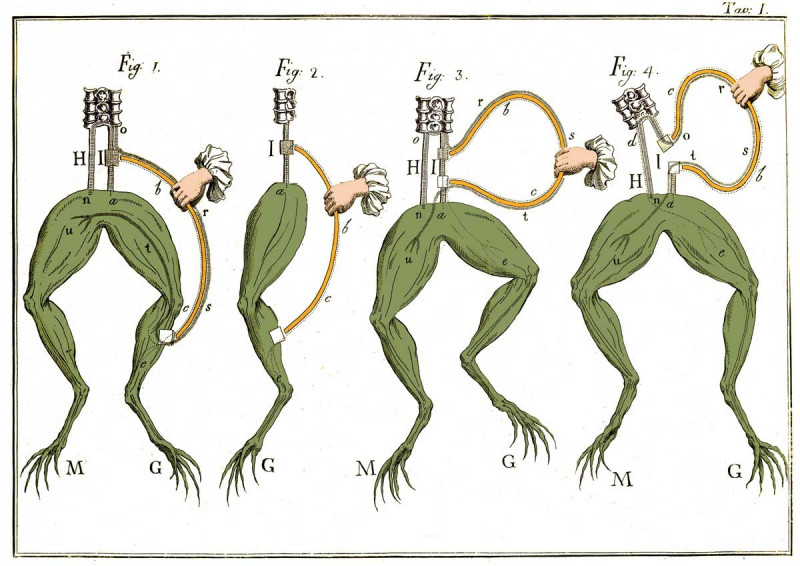
In the 18th and 19th centuries, researchers searching for the secrets of electricity turned to a highly unusual power source: dead amphibians. The frog battery, a type of biobattery constructed from multiple frogs connected in a series, became a critical tool in early scientific electrical investigations.
While modern devices rely on lithium and alkaline, early scientists utilized skinned frog legs and exposed nerves to generate electrical currents. These biological power sources successfully decomposed chemicals and sparked intense scientific debates. Here is the historical account of how researchers physically constructed and utilized muscular piles to harness animal electricity.
Constructing a Biobattery from Amphibian Muscles
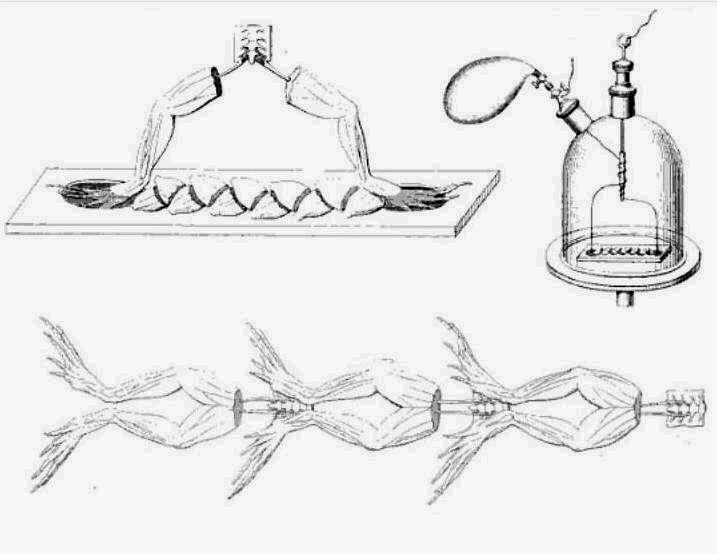
To build these biological circuits, experimenters kept a steady supply of live frogs because their legs were highly sensitive to electric currents. The standard preparation required skinning the frog legs and cutting off the lower portion at the knee. Scientists then cut the thigh muscle in half transversely, keeping only the conical lower piece.
These half-thighs were arranged on varnished wood insulators. The inside surface of one muscle was placed in direct contact with the outside surface of the next. Cups of water at the ends of the wooden pile acted as the battery terminals. Although scientists at the time believed current flowed continually from inside to outside, the electrical generation was actually caused by the injury potential resulting from the tissue dissection.
The Scientific Dispute Over Animal Electricity
Eusebio Valli constructed the first frog battery in the 1790s, linking ten frogs in a chain. Valli believed in galvanic or animal electricity, directly opposing Alessandro Volta, who argued for metal-based electricity. Because Volta successfully built the voltaic pile without animal tissue, Valli’s biological battery fell into obscurity.
In 1818, Leopoldo Nobili built a frog pile using whole legs. Volta criticized this experiment, arguing that the true electrical source was the dissimilar metals in the external circuit, while the frog fluids simply acted as an electrolyte.
Carlo Matteucci and the Power of Half-Thighs
The first widely known frog battery was constructed by Carlo Matteucci in 1845. His design, presented to the Royal Society by Michael Faraday, consisted of 12 to 14 half-thighs. Matteucci aimed to bypass Volta’s criticisms by building a circuit entirely out of biological materials.
This amphibian-powered device was strong enough to decompose potassium iodide. Matteucci also tested his battery in a vacuum and exposed it to toxic gases and poisons, discovering that the electrical output remained unaffected even by substances lethal to living animals.
Beyond Frogs: Generating Electricity from Oxen and Birds
Frogs were not the only biological materials used in early electrical experiments. In 1803, Giovanni Aldini created a biobattery using the freshly killed heads of oxen. By linking two or three ox heads together, Aldini generated an electrical reaction that traveled through his own body. Expanding on this concept in the 1840s, Matteucci created similar batteries using eels, rabbits, and pigeons. He even successfully wired together living pigeons by connecting a wound on one bird’s breast directly to the body of the next.