
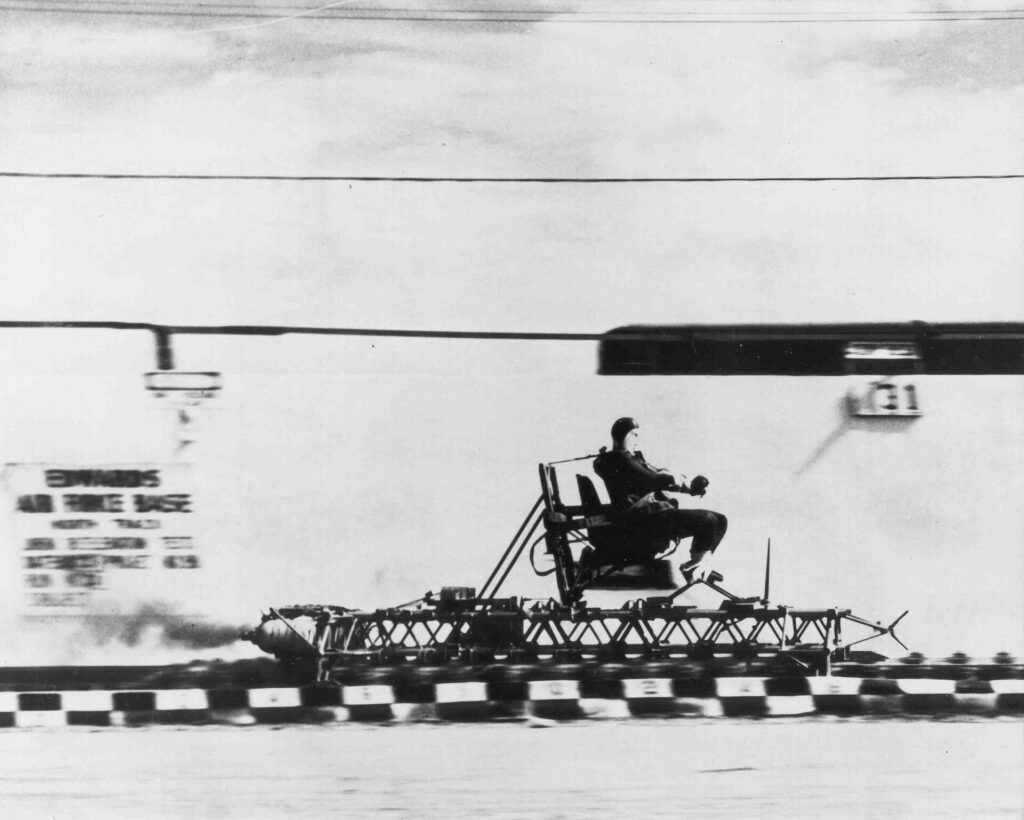
On December 10, 1954, an American physician and United States Air Force officer strapped himself into a rocket sled at Holloman Air Force Base. Moments later, he reached a land speed record of 632 mph before coming to a sudden, violent stop. He subjected his body to 46.2 times the force of gravity to see how much acceleration a human being could survive.
John Paul Stapp volunteered for these extreme physical trials to gather biological data. His work on deceleration fundamentally altered aviation safety standards and the development of high-speed aircraft harnesses.
Developing the Deceleration Project
As early as 1945, military personnel needed a controlled series of studies to understand how deceleration affects the human body. The Aero Medical Laboratory set up a program to simulate aircraft crashes and study the physical strength factors of seats and harnesses.
Stapp entered the Air Force in 1944 and was assigned to the deceleration project in 1947. The first rocket sled run took place in April 1947 using ballast. By December of that same year, human trials began. Researchers initially used backward-facing positions before moving to forward-facing runs in 1949.
Injuries on the Track
By June 1951, the team completed 74 human runs on the decelerator. Stapp served as one of the most frequent volunteers. During these high-speed deceleration tests, he sustained multiple physical injuries. He fractured his right wrist on two separate occasions and broke several ribs.
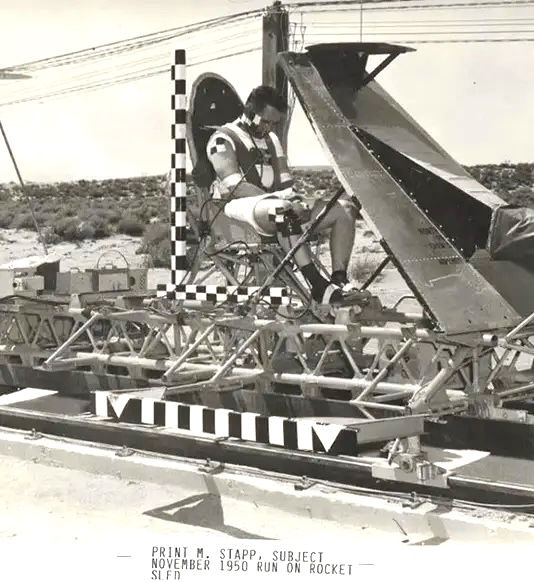
The intense forces knocked the fillings out of his teeth. On one specific run, he experienced bleeding into his retinas, which caused temporary vision loss. Stapp recorded surviving forces up to 38 g during this early period of testing.
Advancing Aviation Safety
The data gathered from the rocket sled runs proved that the backward-facing position was the safest for aircraft passengers. Many military transport aircraft were retrofitted with these specific seats. Stapp also developed new safety equipment, including a side-saddle harness made of nylon mesh webbing for paratroopers.
Furthermore, he designed a high-strength pilot harness featuring an inverted strap crossing the thighs. This new harness withstood 45.4 g, distributing pressure evenly over stronger body surfaces rather than concentrating it on the solar plexus.
The 632 MPH Record
During his 29th and final ride on the decelerator sled, Stapp set a record that earned him the title of the fastest man on Earth. Traveling at 632 mph, he endured 46.2 g in the forward-facing position. He described the physical sensation in his eyes as being similar to the extraction of a molar without anesthetic.
Stapp survived the ordeal without permanent injuries. He also participated in wind-blast experiments, flying in a jet at 570 mph with the canopy removed. Alongside his medical research, he popularized Murphy’s Law and coined Stapp’s Law regarding human ineptitude.