
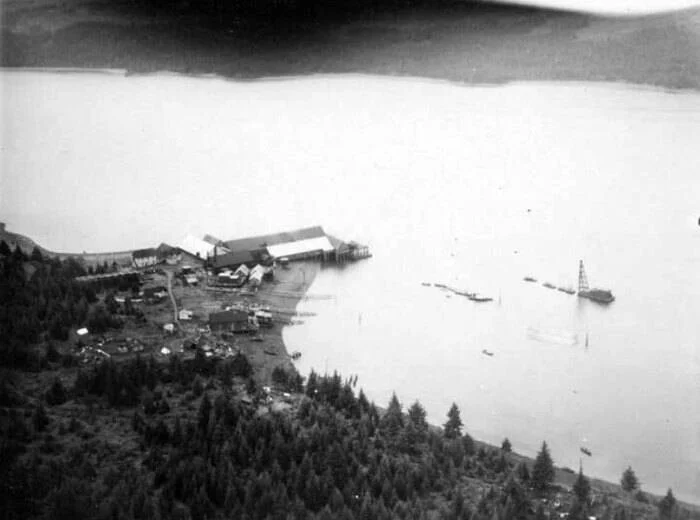
On the southern coast of Alaska, a mining tunnel, scattered rubble, and rusted canning equipment mark the spot where a village once stood. Nestled on the edge of the Kenai Peninsula along Port Chatham bay, the town of Portlock was permanently abandoned by its residents by 1950.
The official explanation points to highway construction and economic shifts, but an urban legend blames a massive, hairy creature known to locals as the Nantiinaq. The sudden desertion of the village sparked decades of rumors involving mysterious disappearances, mutilated bodies, and giant footprints.
The Rise and Fall of a Cannery Town
Captain Nathaniel Portlock of the British Royal Navy passed through the area in 1786. The settlement eventually took his name, growing at the dawn of the 20th century after the construction of a salmon cannery. By 1921, the diverse population of fishermen, miners, and cannery workers—primarily of Russian and Alaska Native descent—was large enough to necessitate a post office.
However, this growth halted quickly. By 1950, the post office closed. Residents relocated to nearby towns like Nanwalek and Seldovia. Officially, the population shifted to be closer to the new Alaska Route 1 state highway, seeking better access to schools, churches, and economic stability.
Decades of Mysterious Alaskan Encounters
According to local rumors, disturbing events began shortly after the town was established. In 1905, Native American cannery workers left temporarily, citing an unseen presence in the woods. During the 1920s, reports emerged of trees torn out by their roots near a local mine. In 1931, a logger named Andrew Kamluck died after being struck by a piece of logging equipment reportedly too heavy for a human to lift. His body was found 10 feet (3.05 meters) away from a bloody crane.
During the 1940s, hunters tracking a moose reported finding grass matted down from a struggle, followed by 18-inch (45.7-centimeter) footprints leading into the mountains. Another account detailed missing cannery workers, with one body allegedly discovered mutilated in a local lagoon.
The Truth Behind the Nantiinaq Legend
The name Nantiinaq comes from the Native Alaskan Dena’ina word “nant’ina,” translating to “those who steal people.” Former resident Malania Kehl stated that residents fled because something terrorized them over a long period. Her cousin, Sally Ash, later clarified that Kehl fabricated the violent aspects of the story to satisfy curious outsiders.
Ash maintained that no killings occurred and that the true reason for the exodus was purely socioeconomic. While Ash still expressed belief in a tall, hairy, and foul-smelling creature living in the nearby woods, she described it as an elusive entity that kept its distance. Ultimately, the town emptied out as residents sought modern infrastructure elsewhere.