
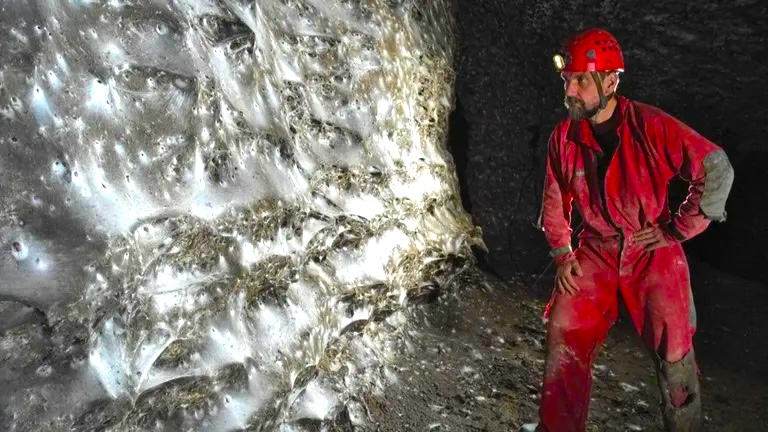
Deep underground on the border between Albania and Greece, scientists made an unprecedented discovery inside a pitch-black cavern known as Sulfur Cave. Cavers exploring the Vromoner Canyon stumbled upon a colossal, patchwork structure stretching across the walls of a narrow, low-ceilinged passage.
They found what scientists now confirm is the largest spider web ever documented. The massive formation houses a megacity of over 111,000 arachnids from two distinct species that typically do not live together. The details of this extraordinary colony, published in the journal Subterranean Biology, reveal a fascinating biological occurrence driven by a unique underground environment.
A Massive Web Spanning Thousands of Feet
The record-breaking web covers exactly 1,140 square feet, or 106 square meters, of the cave wall. In 2022, members of the Czech Speleological Society first noticed the web.
A team of scientists subsequently visited the location in 2024 to collect specimens for analysis. The lead author of the resulting study, István Urák from Sapientia Hungarian University of Transylvania, reported that the immense structure is formed by thousands of individual, funnel-shaped webs woven together into a single continuous fabric.
Two Spider Species Living in One Colony
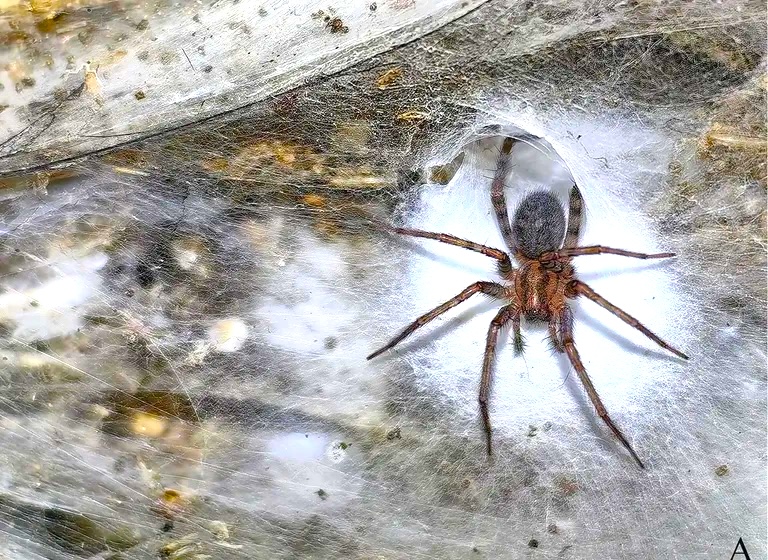
Analysis of the captured specimens showed that the web is inhabited by two separate species. The population includes approximately 69,000 barn funnel weavers, scientifically named Tegenaria domestica, alongside 42,000 Prinerigone vagans spiders. Under typical circumstances outside of cave environments, these arachnids are solitary creatures.
Furthermore, researchers usually expect the larger barn funnel weaver to prey upon Prinerigone vagans. Instead, DNA and gut content analyses confirmed these two species cohabitate and populate the dark environment together.
An Unusual Diet Driven by Extreme Darkness
The cavern was hollowed out by sulfuric acid formed from hydrogen sulfide in the groundwater. A sulfur-rich stream flows through the cave, feeding microorganisms that produce white microbial biofilms.
Huge clouds of non-biting midges eat these biofilms. Because the total darkness of the cavern impairs the spiders’ vision, they do not hunt one another. They feast entirely on the abundant midges. The massive food supply sustains the unprecedented density of spiders without triggering predatory behavior between the two species.
Genetic Adaptations to a Harsh Environment
The sulfur-rich diet directly influences the spiders’ internal biology. Gut content testing revealed that the cave spiders possess a significantly less diverse microbiome compared to their surface-dwelling counterparts.
Molecular data further demonstrated distinct genetic differences between the cave populations and external relatives. The arachnids have physically adapted to the extreme conditions of Sulfur Cave. Researchers are currently preparing another study to uncover additional facts about this enormous subterranean colony and its unique biological composition.