
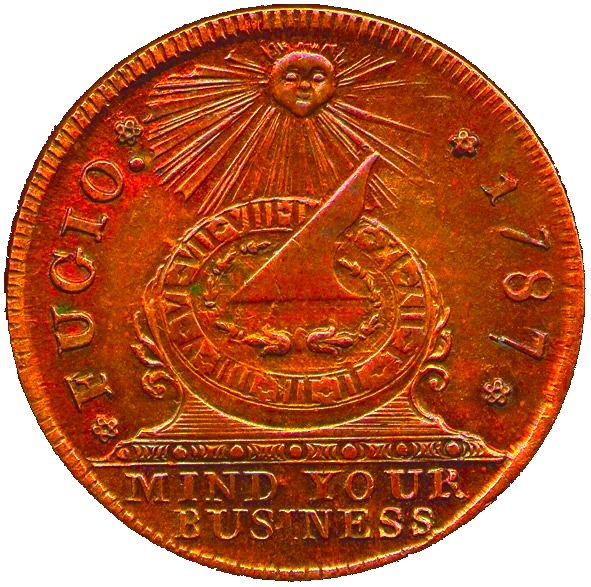
In 1788, a wooden keg filled with thousands of copper coins was sealed away in the basement of the Bank of New York. The heavy barrel hid a massive cache of the first official circulation coin of the United States. Minted in 1787 and weighing exactly 0.36 oz (10 g), this copper piece features a direct financial instruction and a Latin word that gave the currency its name: the Fugio cent. The precise history behind its creation, the physical details linked to Benjamin Franklin, and the discovery of that basement hoard present a documented record of early American coinage.
Designing the 1787 Franklin Cent
On April 21, 1787, the Congress of the Confederation authorized a design for a new official copper penny. According to several historical accounts, Benjamin Franklin created the layout. The front features the Sun shining its light down on a sundial. Above this sits the word “Fugio,” which translates from Latin to “I flee” or “I fly,” referring to the rapid passage of time. Along the bottom edge, the coin reads: “Mind your business.” The layout closely mirrored the 1776 Continental Currency dollar coin, a project that only produced uncirculated pattern pieces.
Thirteen Links on the Reverse Side
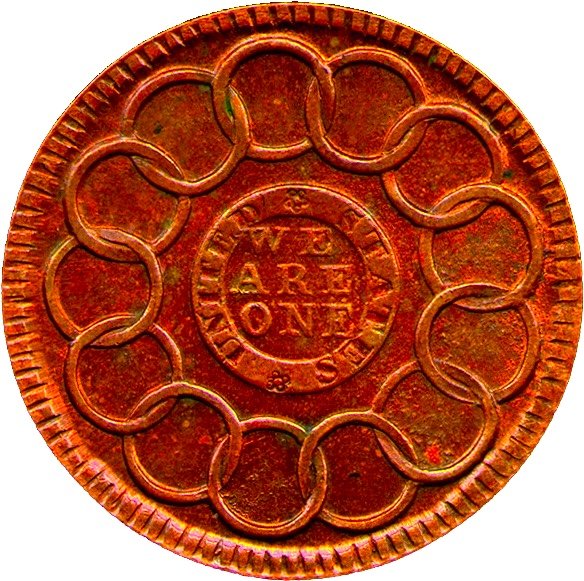
The back of the 1787 Fugio cent carries an entirely different set of engravings. At the direct center, the English words “We Are One” are stamped into the copper. Surrounding this text is a continuous circle made of thirteen interconnected chain links. These individual links correspond to the original thirteen colonial states. The Fugio cent maintained this specific motto until the ratification of the United States Constitution in 1788. After the central government reformed, subsequent gold and silver coins adopted the motto “E pluribus unum” directly from the Great Seal of the United States.
The Bank of New York Hoard
The history of this currency shifted when the Bank of New York stored thousands of the copper pieces in a basement keg in 1788. Bank workers transferred the coins into cotton bags in 1856, leaving them undisturbed until their rediscovery in 1926. For two decades, the bank handed out the pristine coins as keepsakes to clients. In 1948, the American Numismatic Society examined the remaining 1,641 pieces. The coins were found in mint state condition. Many exhibited brown toning and some showed distinct water damage.
Modern Numismatic Reclassification
Following the 1948 examination, the collection officially became known as the Bank of New York Hoard. The bank donated several specimens to the American Numismatic Society and sold others to private collectors. The institution retained 819 of the coins in its own vaults. The Fugio cent has maintained high demand among specialists in early Federal coinage. In January 2022, major coin grading services officially re-classified the piece, categorizing it as a regular-issue United States coin.