
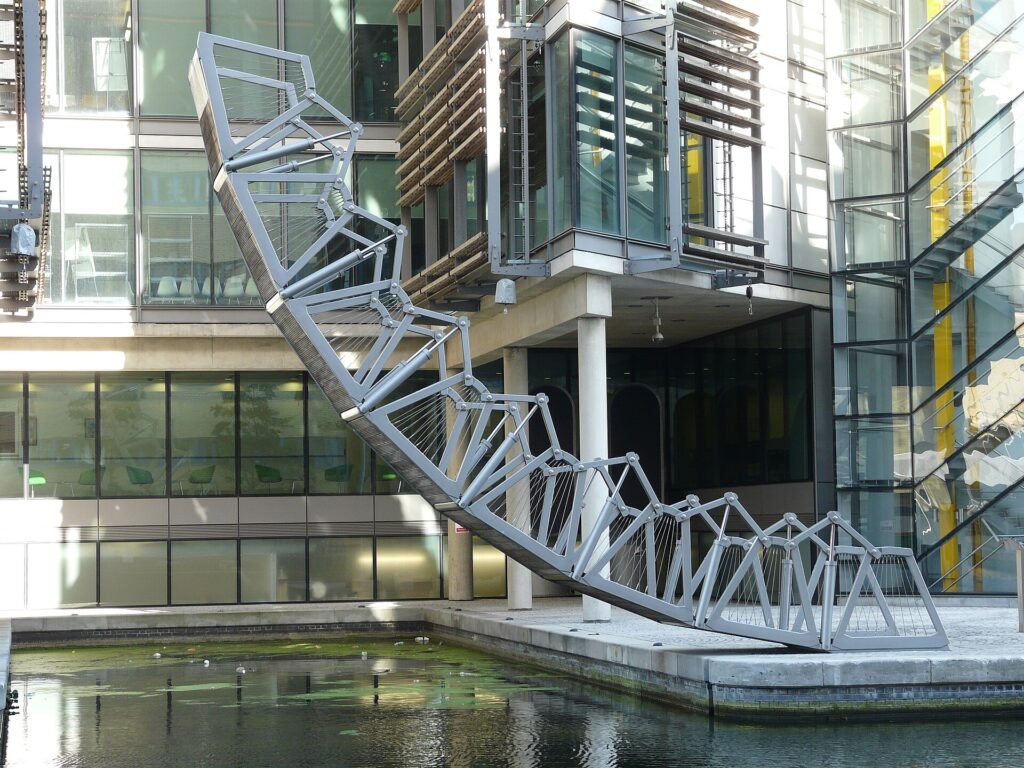
In 2004, the Paddington Basin area of London saw the completion of an unusual structure across the Grand Union Canal. Rather than a static pathway, this 12-metre (39-foot) steel and timber crossing physically transforms on a schedule. Designed to lift and coil upon itself, it shifts from a traditional horizontal footbridge into an upright octagonal shape.
While it crosses a waterway, its primary role diverges from typical civil engineering. Exploring the mechanics, the specific design choices, and the historical use of its name reveals the exact nature of this kinetic installation.
A Structure That Curls Into an Octagon
Thomas Heatherwick conceived the Rolling Bridge as part of an office and retail development project. The structure consists of eight triangular sections that span 12 metres (39 feet) when fully extended. These sections are joined at the walkway level by hinges. Above the walkway, two-part links connect the sections.
When activated, vertically mounted hydraulic cylinders pull these links toward the deck. This action causes the bridge to curl upward until the two ends meet, forming a complete octagon. In its coiled state, the structure takes up exactly half the width of the canal crossing.
The Complex Machinery Beneath
The movement relies on a high number of intricate parts. The system utilizes fourteen hydraulic rams and numerous precision bearings. An underground machinery chamber provides the required oil pressure to operate the pistons. Moving the entire span in either direction takes two to three minutes, a cycle time longer than hand-operated canal footbridges.
The structure won the British Constructional Steelwork Association’s British Structural Steel Design Award. However, the complex moving components have occasionally caused maintenance failures, leaving the bridge stuck for extended periods.
Navigation versus Public Art
The actual location of the Rolling Bridge minimizes its utility as a necessary crossing. The basin directly behind the bridge houses a fountain and is blocked by a surface-level steel barrier, preventing any boat traffic from passing through. Additionally, the walking detour around the open bridge is very short.
Because the crossing is not strictly required and the bridge does not facilitate boat passage, the structure functions primarily as public art. Critics have noted that this approach disregards established engineering principles like form follows function, similar to the criticism of Heatherwick’s Garden Bridge proposal.
The Victorian Origin of the Name
The naming of the structure references a historical type of crossing, though the mechanical operation differs. During the Victorian era, a “rolling bridge” described a retractable drawbridge that spanned fort ditches. Those older designs remained perfectly horizontal and rolled backward inside fort gates, rather than curling.
One specific historic model is the Guthrie rolling bridge, which is still visible at Fort Nelson in Portsmouth. Today, modern horizontal versions are usually called retractable or thrust bridges, while bascule bridges, like the Pegasus Bridge, roll on an arc.