
Earth is a terrible timekeeper. While our ancient ancestors relied on the rising and setting sun to divide their lives, modern science reveals a planet constantly changing its spin. No two rotations are ever exactly the same length.
From deep earthquakes and the gravitational pull of the moon to massive human-built megastructures, countless forces stretch and compress the duration of a single day. The massive water reservoirs we construct actually hit the brakes on our spinning world.
The Natural Pressures Altering Our Clocks
Our planet’s rotation fluctuates due to internal and external pressures. The moon tries to hold our oceans in place while the planet turns beneath them. This tidal friction drains rotational energy, lengthening the day by two milliseconds per century.
Short-term events create sudden shifts. The 2011 earthquake in Japan sped up the rotation by 1.8 millionths of a second. Conversely, deep core changes caused June 29, 2022, to become the shortest day ever recorded at 1.59 milliseconds faster than average.
The Massive Weight of the Three Gorges Dam
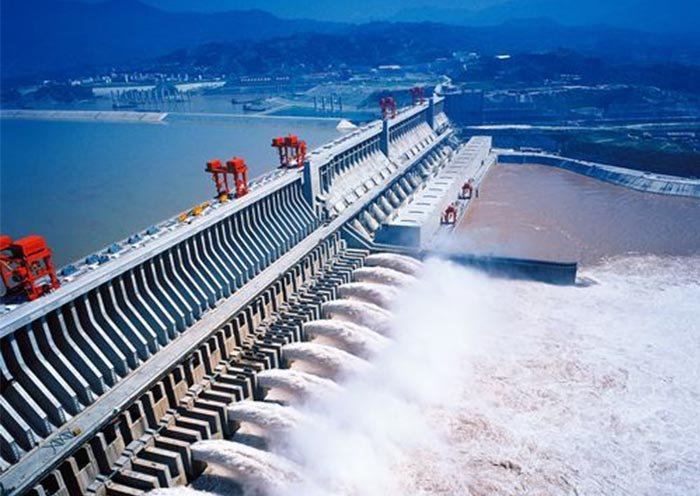
Humans directly alter the planet’s spin. The Three Gorges Dam in China spans the Yangtze River and stands 185 meters (607 feet) tall and over 2,300 meters (7,546 feet) long.
The reservoir holds 40 billion cubic meters (1.4 trillion cubic feet) of water. In 2005, NASA scientist Dr Benjamin Fong Chao calculated that concentrating this much mass in one location impacts planetary rotation. When full, the dam increases the length of a day by 0.06 microseconds and shifts the poles by 2 centimeters (0.8 inches).
The Physics Behind a Slower Planet
This phenomenon relates to the moment of inertia and angular momentum. When an object has more mass situated further from its center of rotation, it resists spinning. Think of an ice skater. When they draw their arms in, they spin faster. When they stretch their arms out, their rotation slows to conserve total angular momentum.
Raising 40 billion cubic meters (1.4 trillion cubic feet) of water 185 meters (607 feet) above sea level moves mass away from the rotational axis, forcing the planet to slow down. Similar conservation of momentum causes the moon to drift away from us by 3.8 centimeters (1.5 inches) per year.
Navigating a Constantly Shifting World
Other human activities cause even larger disruptions. The draining of Lake Aral altered the rotation three times more than the dam, and Greenland’s melting ice shifts the axis ten times as much. These minuscule fractions of a second matter immensely for space agencies. Satellites and interplanetary probes require exact rotational data to navigate successfully.
Because our planet fluctuates unpredictably, scientists abandoned it as a timepiece. Today, a second is measured by the oscillation of a caesium atom, leaving the planetary spin behind.