
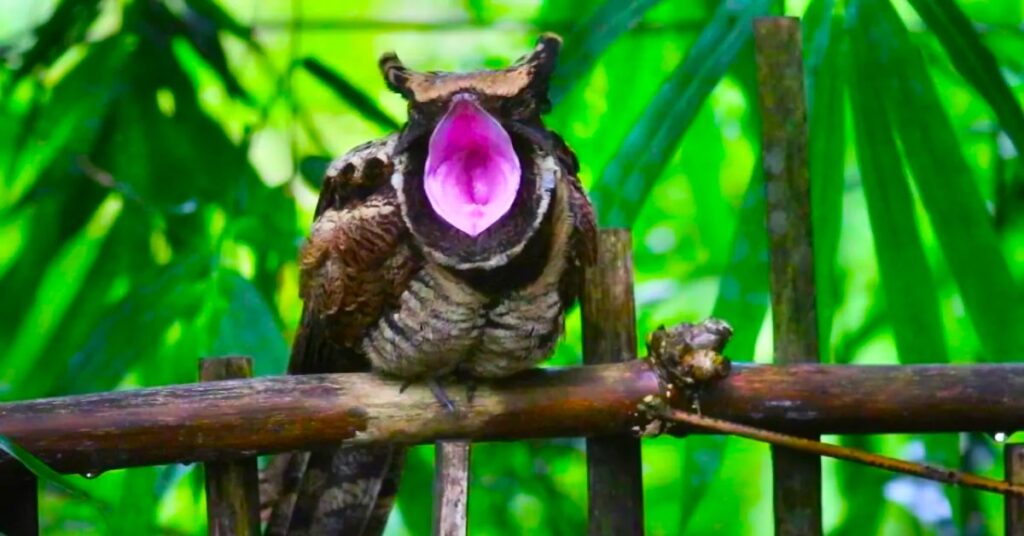
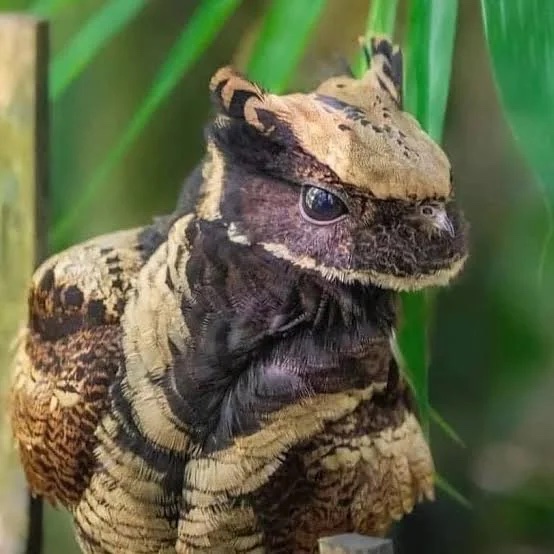
Deep in the forests of Southeast Asia lives a creature resembling a cross between an owl, a hawk, and an alien. With a wide mouth, distinctive ear-tufts, and a striking resemblance to a baby dragon, this five-ounce bird is known as the great eared nightjar.
Equipped with unique physical traits and specialized survival techniques, this elusive creature easily evades predators like foxes, dogs, owls, and snakes. These birds rely on their elusive nature, flight skills, and physical appearance to survive in the wild.
The Origins of a Unique Species
The great eared nightjar, scientifically named Lyncornis macrotis, was described by zoologist Nicholas Aylward Vigors in 1831. It got its common name because it flies at night, and its whistling birdsong—a “tsiik” followed by a “ba-haaww”—was considered jarring.
This small creature measures sixteen inches across its wingspan and features a long tail. While nightjars are found all over the world, the great eared nightjar is exclusively found in regions of Southeast Asia, including Vietnam, Thailand, Indonesia, the Philippines, and parts of India.
Camouflage on the Forest Floor
Unlike many birds, great eared nightjars lay their single egg directly on the ground. They must guard it for approximately four weeks. To protect their offspring, these birds rely heavily on their ability to blend completely into their surroundings.
According to lead researcher Martin Stevens, individual birds consistently select resting places that specifically enhance their own unique visual markings against the background habitat.
Aerial Agility and Night Vision
To avoid diurnal predators, the great eared nightjar operates primarily at night, dawn, and dusk. Their large eyes contain a tissue layer known as the tapetum lucidum, which reflects light through the retina to provide night vision. This specific tissue feature is also found in animals like cats and crocodiles.
They are constantly on the move and spend a vast majority of their time airborne. They catch flying insects, such as moths and beetles, and even swoop over ponds and lakes to drink water mid-flight.
Eerie Legends Across the Globe
The bird’s nocturnal habits and gaping mouth have generated unsettling myths. In Indonesia, the satanic nightjar has an eerie call that sounds like eyes being plucked out. European poets referred to nightjars as the “corpse bird” due to a death association, while ancient Greeks incorrectly believed they drank milk right out of the udders of goats.
Despite these frightening myths, the great eared nightjar remains entirely harmless to humans, focusing on catching bugs and protecting eggs.